Training Rooms Atlanta: What Companies Should Look For
Companies across Atlanta are moving away from repurposed conference tables and makeshift office setups for their training programs. From tech startups clustered around Atlanta Tech Village to global brands headquartered near Peachtree Center, the shift toward dedicated training rooms is accelerating. This guide is written for HR, L&D, operations, and marketing teams planning workshops, onboarding cohorts, quarterly trainings, or content-driven sessions in the city.
Atlanta Training Rooms at a Glance
Atlanta's position as a transportation and corporate hub makes it one of the strongest markets in the country for professional training and meeting rooms. Hartsfield-Jackson International Airport connects teams from across the nation and globe, while the concentration of Fortune 500 headquarters and a booming film and tech sector keeps demand for high-quality event space consistently strong. There are over 922 workshop spaces available for rent in atlanta today, ranging from intimate rooms for six people to large multifunctional facilities that can hold hundreds.
This article covers what matters most when selecting training rooms in atlanta: how to choose the right neighborhood and location, which room types and layouts work for different training goals, the technology and amenities your team should expect, how to handle catering and budgeting, and what to look for in contracts. Whether your next event is a two-day sales kickoff or a half-day compliance session, the details here will help you book with confidence.
Why Atlanta Is a Prime City for Corporate Training
Atlanta's economy, talent pipeline, and infrastructure create an environment where corporate training isn't just common-it's expected. The city is home to a dense community of professionals across industries, supported by major research institutions and a workforce accustomed to structured learning.
Metro Atlanta's GDP reached approximately $570.663 billion as of 2023, making it one of the largest metro economies in the United States. Major employers like Coca-Cola, Delta Air Lines, Home Depot, and UPS anchor the business landscape, and nearly 75% of Fortune 1000 companies maintain operations in metro atlanta. This corporate density drives a mature market for meeting space, conference rooms, and dedicated training facilities.
Flying teams into atlanta via Hartsfield-Jackson-frequently rated the busiest airport in the world-is straightforward. Hundreds of nonstop domestic and international routes make it a cost-efficient choice for multi-day training cohorts and leadership offsites, particularly for companies with regional offices across the southeastern United States.
Higher-education institutions like Georgia Tech, Georgia State, and Emory University have helped normalize classroom-style learning environments in the city. Many corporate training venues in georgia now emulate these standards in terms of AV infrastructure, seating design, and instructional layout, setting a high baseline for what companies can expect when they rent professional training rooms.
Choosing the Right Neighborhood in Atlanta for Your Training Room
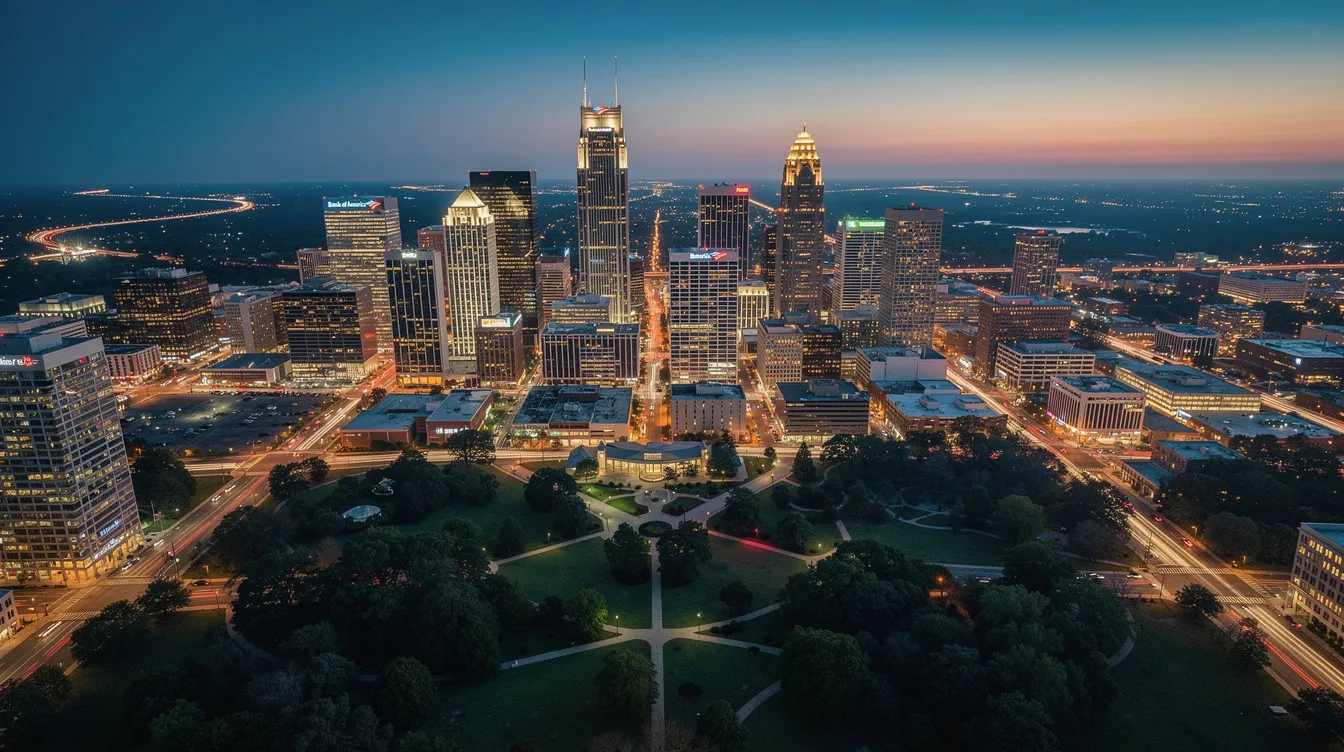
The neighborhood you choose for your training room affects more than cost. It shapes commute times, the perception of your event, and the after-hours options available to your team. For multi-day programs or sessions with out-of-town guests, the surrounding area matters as much as the room itself.
Downtown and the Government District sit near Atlanta City Hall and atlanta city council offices, making them natural fits for public-sector trainings, legal seminars, and compliance workshops. Transit access is excellent here, with MARTA's Five Points and Georgia State stations within walking distance. City government offices, courthouses, and state agencies surround this area, and nearby hotels and restaurants make logistics simple for visitors.
Midtown is a hub for tech, design, and creative firms. The neighborhood is walkable, with convenient location access to hotels, art galleries, the museum district, and cultural venues. Teams can explore live music spots and dining options for evening events, making it a strong choice for multi-day workshops where community building and engagement matter.
Buckhead appeals to companies planning executive trainings, board retreats, or client-facing sessions. Premium hotels, upscale dining, and proximity to GA-400 and Lenox MARTA create an atmosphere of prestige. The trade-off is higher costs across the board.
Emerging areas like west Midtown and the BeltLine corridor-Old Fourth Ward, Inman Park, Ponce City Market-offer innovative, loft-style spaces often housed in a converted warehouse or industrial building. These neighborhoods reflect atlanta's rapid growth and commitment to historic preservation, and they tend to attract creative workshops, content creation sessions, and non-traditional corporate events. Some parking limitations exist, but value for style and scale is often better.
Types of Training Rooms, Conference Rooms, and Meeting Spaces
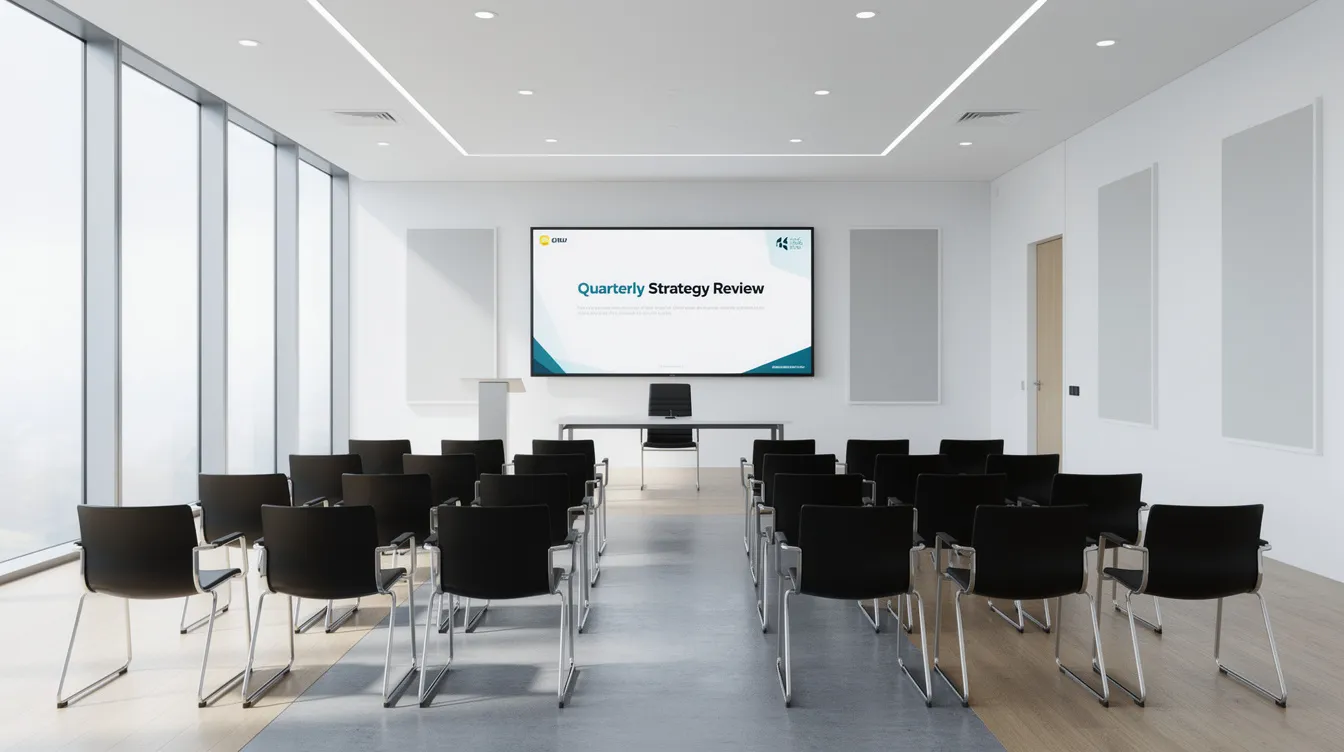
Atlanta offers a full spectrum of room types. Choosing the right one depends on what you need to deliver, how many people you're hosting, and whether your session involves presentations, group work, recording, or all three. Event venues can vary widely in terms of size from small team rooms to larger multifunctional spaces, and several professional training rooms are available for rent across the city.
Traditional conference rooms feature boardroom tables, built-in screens, and teleconferencing equipment. They're typically found in office towers and hotels along Peachtree Street and downtown corridors. Standard conference rooms can accommodate up to 20 people comfortably and are best suited for executive meetings, client presentations, and high-stakes discussions. Rooms often feature whiteboards, TVs, and reliable internet.
Classroom and seminar rooms use fixed or flexible rows of desks facing the front of the room. These are ideal for certification training, software rollouts, and continuing education sessions where attendees need writing surfaces and laptop space. Atlanta training venues offer various capacities depending on the specific room configuration, from 20-person seminars to 100-person lecture-style setups.
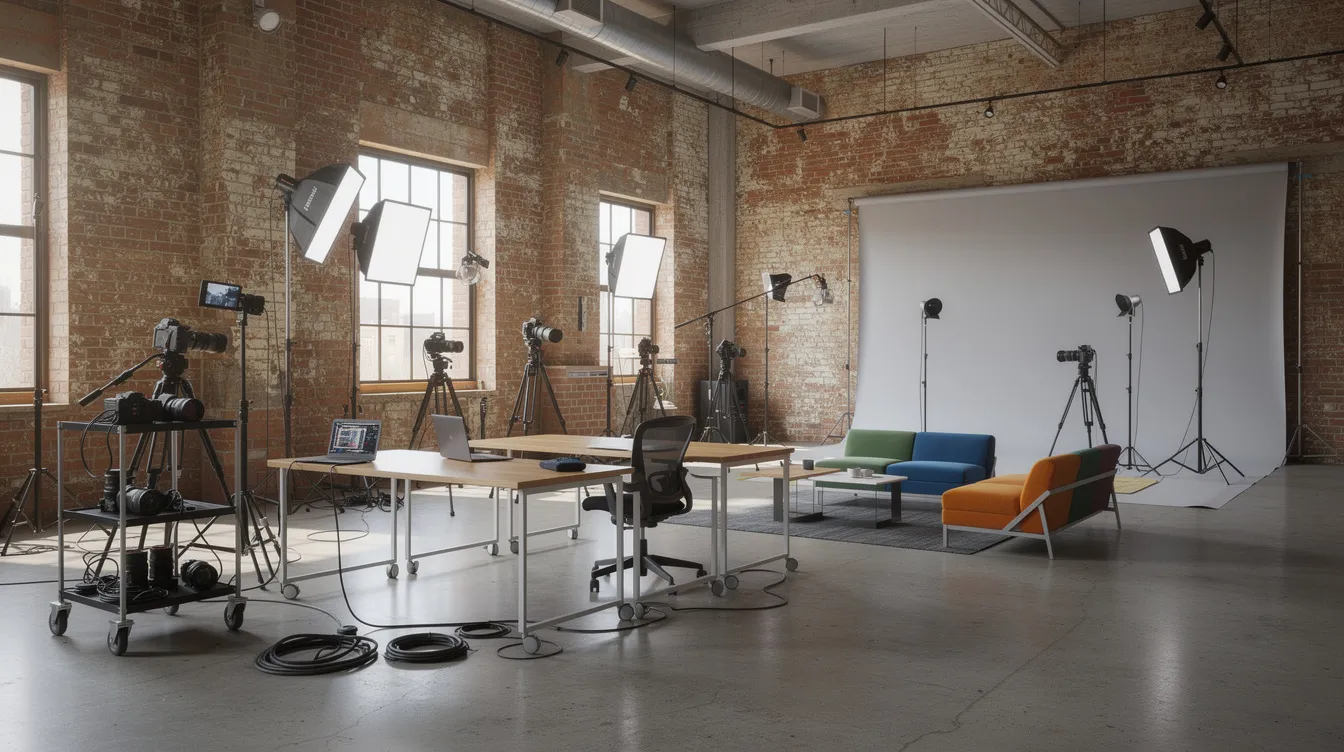
Creative and studio-style spaces provide open layouts, movable furniture, writable walls, and content-ready setups. Workshop spaces in atlanta include modern and industrial designs suited for design sprints, marketing workshops, brainstorming sessions, and on-camera training recordings. Common amenities across training venues may include whiteboards and complimentary beverages.
Collaboration zones and breakout rooms support small-group activities, coaching sessions, and side meetings during full-day programs. Providers like Davinci Meeting Rooms offer thousands of locations for rentals, giving companies flexible options for breakout rooms alongside their primary training space. Meeting rooms in atlanta can accommodate various professional events, from quick huddles to intensive all-day workshops.
Room Layouts and Seating Styles That Actually Work
Layout determines how engaged attendees will be and how easily facilitators can manage activities throughout the day. The same room can feel productive or chaotic depending on how chairs, tables, and screens are arranged. Flexible seating options in training rooms include classroom and U-shaped layouts, among others. Meeting rooms include chairs for the established number of guests expected.
Here are the formats that work best for corporate training:
- Classroom style (rows of tables facing front): Best for technical training, software onboarding, and certification courses where note-taking and laptop use are central.
- Theater style (chairs only, no tables): Maximizes capacity for keynotes, town halls, and large briefings where writing surfaces aren't needed.
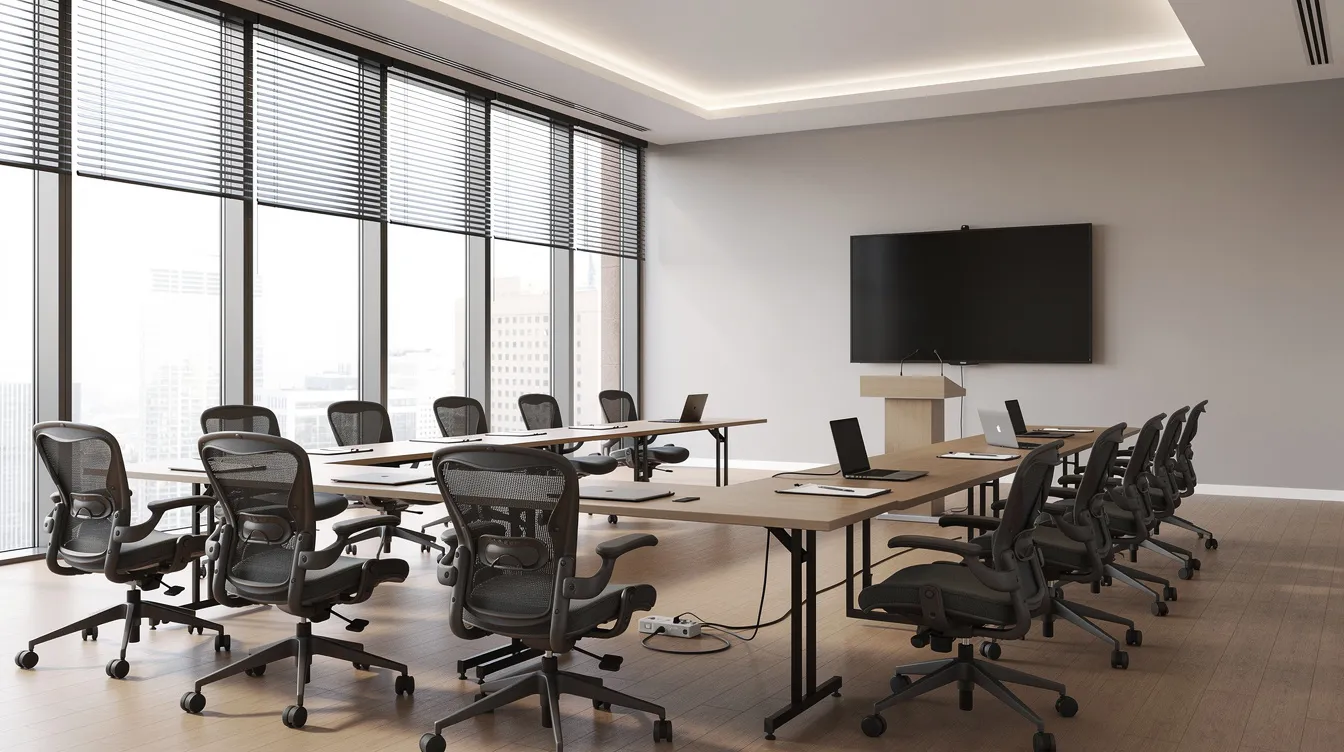
- U-shaped (tables in a horseshoe with the facilitator inside or outside): Strong for discussion-led workshops, leadership development, and sessions where every participant needs to see each other.
- Pod or cabaret (small group tables of 4–8): Encourages collaboration and is excellent for group exercises, case study work, and team-based problem solving.
- Hollow square (tables forming a rectangle with open center): Useful for committee meetings, strategy sessions, and project planning where equal participation matters.
Match layout to objective. A 40-person software onboarding runs best in classroom style, while an 80-person sales kickoff might combine theater seating with adjacent breakout pods. Atlanta companies should leave space for cameras and tripods if recording, ensure ADA-compliant aisle widths, and orient screens away from large windows-bright southern sun can wash out projectors. Request sample floor plans from venues to visualize your setup before committing.
Technology and A/V Standards for Modern Atlanta Training Rooms
Technology should be a primary selection factor, not an afterthought. This is especially true for hybrid meetings and sessions where you plan to capture content for future use. Training rooms are typically equipped with high-speed Wi-Fi and projectors, but the range of quality varies significantly. Factors influencing training room selection include AV equipment, room size, and location.
Essential A/V features to confirm before booking:
- Large displays (dual 75" to 98" screens) or high-lumen laser projectors that remain visible even in bright Atlanta daylight
- Multiple HDMI and USB-C input ports, plus compatibility with apple tv or similar wireless presentation devices
- Reliable sound systems with ceiling or wall-mounted speakers
- Some spaces offer overhead projectors and multimedia inputs for more complex presentation setups
For reference, the Cisco-designed training room at Georgia Tech's Tech Square uses dual 98-inch displays, ceiling microphones, a rear PTZ 4K camera, and a writable board-an example of what a fully equipped modern training environment looks like.
Hybrid-meeting requirements now represent a baseline expectation. Venues should offer room cameras that capture both speaker and audience, ceiling or boundary microphones, Zoom and Teams compatibility, and dedicated screens for remote participants. Request minimum Wi-Fi speeds of 50–100 Mbps for groups of 50, and confirm whether a wired backup line is available. Atlanta's meeting spaces often feature modern amenities and technology, but verify specifics rather than assuming.
Recording capabilities matter for teams building internal training libraries. Look for sound-treated rooms with minimal echo, XLR or professional mic hookups, and integrated recording hardware. Ask whether the venue can support multi-channel audio and video capture for later upload to your LMS.
Always request an onsite tech checklist from the venue. Schedule a short A/V test run the week before your event and confirm whether same-day technical support is included or billed separately. Meeting room rentals typically include reliable internet and seating for guests, but AV support staffing varies.
Comfort, Lighting, and Acoustics: Keeping Attendees Engaged
Room comfort directly affects attention spans. A poorly ventilated room or a chair that digs into someone's back at hour three will undermine even the best-designed agenda. Here's what to evaluate.
Seating should be ergonomic. Look for chairs with adjustable height and armrests, and tables or surfaces large enough for laptops, notebooks, and beverages. Avoid layouts where attendees are packed elbow-to-elbow-cramped environments create fatigue and frustration. Allow enough space for people to stand, stretch, and move between sessions without disrupting others.
Lighting is a balancing act. Natural light boosts energy and mood, which is valuable during long training days. But Atlanta's strong southern sun, particularly in afternoon hours, can wash out screens and create glare. Venues should have reliable blinds or blackout options so facilitators can shift between natural light during discussions and dim conditions during presentations.
Acoustics are often overlooked until they become a problem. Street noise from busy corridors like Peachtree Street, HVAC hum, hallway foot traffic, and sound bleed from adjacent event rooms can all disrupt focus. Ask about acoustic panels, double-glazed windows, and soundproofing between rooms. If your training involves sensitive discussions or recorded content, sound isolation is essential.
Climate control is critical in Atlanta's humid subtropical climate. Indoor spaces should have reliable HVAC systems with independent thermostats for the training room zone. During summer sessions especially, airflow and temperature consistency are more than a comfort issue-they're a productivity issue. Confirm that the venue can maintain stable conditions regardless of headcount or outside weather.
Location, Parking, and Transportation for Atlanta Attendees
Accessibility is often the deciding factor for attendance and punctuality. A venue in the perfect place on paper loses its appeal if attendees can't get there without a 45-minute parking search.
Public transportation access is a significant advantage in Atlanta. MARTA rail stations like Peachtree Center, Civic Center, Arts Center, and Buckhead provide car-free access to many of the city's best training facilities. For attendees coming from across the city or from the airport, proximity to a MARTA stop can be the difference between an on-time arrival and a missed opening session.
Parking realities vary by neighborhood. Downtown and midtown garage rates range from $10 to $30 per day depending on the facility, and some hotels offer validation for event attendees. Surface lots are more common in west Midtown but can fill up during busy weekdays. Rush-hour traffic on the Downtown Connector (I-75/85) should directly influence your scheduling-starting at 9:30 AM instead of 8:30 can dramatically reduce stress for attendees driving in.
Airport access matters for out-of-town members. Hartsfield-Jackson is roughly 15–25 minutes from downtown atlanta with light traffic, but that window can stretch to 45 minutes or more during peak hours. If many attendees are flying in, coordinate session start and end times around realistic airport logistics.
Include arrival maps, garage and parking instructions, and public transport directions in your pre-event communications. This small step reduces no-shows and late arrivals and shows attendees you've thought through the logistics of the occasion.
Catering, Breaks, and Keeping Teams Fueled
Food plays a larger role in training outcomes than most planners realize. It keeps energy high, creates natural networking windows, and gives attendees a reason to engage with each other outside of structured content. Many meeting spaces include kitchenettes and catering areas, which can simplify logistics considerably.
Typical catering options at Atlanta training venues include continental breakfast, boxed or buffet lunches, coffee and tea stations, and mid-session snack breaks. Some venues partner with local restaurants or approved caterers who can deliver regional favorites alongside standard corporate fare. Hotels often have in-house catering with higher per-person minimums.
Dietary accommodations are no longer optional. Confirm vegetarian, vegan, gluten-free, Halal, and allergy-specific needs at least two weeks ahead. Recent trends show growing demand for plant-based and sustainable food options across corporate groups-being proactive here signals professionalism.
Timing breaks effectively across a 7- to 8-hour agenda means scheduling a mid-morning break around 10:30, a lunch window from 12:00 to 1:00, and a mid-afternoon break near 3:00. Shorter 5- to 10-minute transitions between intensive sessions help prevent mental fatigue.
Outdoor break areas provide a reset that indoor spaces can't match. Nearby parks like Woodruff Park in downtown or Piedmont Park in midtown give attendees a chance to walk, breathe fresh air, and return sharper. Ask venues whether outside catering is allowed, what service fees apply, and whether minimum spend thresholds or kitchen access rules are in play.
Budgeting and Pricing Models for Atlanta Training Rooms
Pricing for Atlanta training rooms varies widely depending on neighborhood, building class, included services, and time of year. Understanding common pricing models helps you build an accurate budget and avoid surprises. Training room pricing varies based on size and amenities, so specificity in your request matters.
Common pricing structures include:
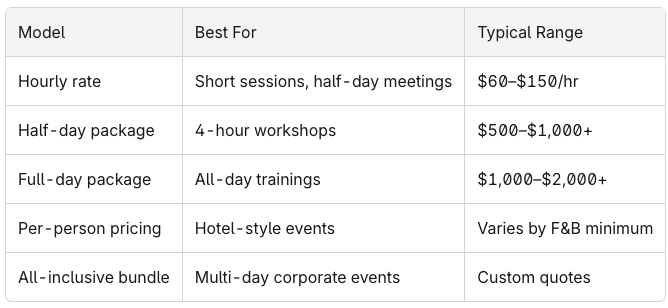
For context, hourly rates for meeting rooms in Atlanta range from approximately $44.64 to $102.54 per hour, with a median around $61 per hour for smaller spaces. Typical hourly rates for small meeting rooms are approximately $60 to $100. Mid-size training rooms usually range from $75 to $150 per hour. Larger conference spaces often require a minimum spend of $300 to $550.
The average meeting room rental rate in Atlanta sits around $197 per hour when factoring in premium spaces, and booking prices for workshop spaces range from $18 to $4,500 per hour depending on size, location, and amenities. There are 922 workshop spaces available in atlanta, with the average rental rate for workshop spaces at $197 per hour.
As a real-world benchmark, Rosewood Training Center offers half-day sessions (4 hours) at $800 and full-day sessions (8 hours) at $1,600, with capacity for 20 in U-shape, 24 in classroom, and 30 in theater. University venues like Emory offer conference rooms at $50 per hour on weekdays and $100 per hour on weekends, with larger community rooms at $150 to $225 per hour.
Additional costs to budget for include AV technician time, parking stipends, after-hours access fees, security requirements, service charges, and taxes. Small businesses and entrepreneurs should also factor in printed materials, travel costs for facilitators, and a 5–10% contingency for last-minute changes. Workshop spaces can accommodate various events like training sessions, so matching the venue tier to your actual needs helps control costs.
Booking Process, Contracts, and Cancellation Terms
Legal and administrative details matter as much as aesthetics when booking meeting rooms. A smooth booking process protects your investment and prevents day-of disruptions.
A typical booking workflow looks like this:
- Submit an initial inquiry or RFP with your dates, headcount, layout preferences, and technology needs
- Schedule a site visit-virtual or in-person-to confirm that the room, lighting, acoustics, and amenities match your expectations
- Receive a detailed proposal listing all fees, included services, and optional add-ons
- Review the contract carefully before signing
- Pay the required deposit according to the payment schedule
- Confirm final headcount, dietary restrictions, and room layout 1–2 weeks before the event
Key contract points to review include the exact rental window (start and end times), whether setup and teardown hours are included or billed separately, overtime rates, security deposit amounts, and who is responsible for damages or lost equipment.
Cancellation and rescheduling terms typically follow 14-day or 30-day notice windows for full or partial refunds, with charges escalating closer to the event date. City-wide events, severe weather (common in atlanta during spring and summer), and corporate travel changes can all trigger rebooking needs-understand your options before you sign.
Ensure the agreement covers data privacy for Wi-Fi networks and recording storage, building access rules for early-morning or weekend sessions, and whether you'll need to provide a certificate of insurance. For companies running recurring quarterly or annual programs, negotiate multi-booking terms upfront to build a more predictable cost structure.
Compliance, Security, and Professional Environment
Some industries have heightened security and compliance needs that directly shape which training rooms and meeting spaces are suitable.
Security expectations near government and legal districts in atlanta are often more rigorous. Controlled building access, visitor check-in systems, ID badges, and coordination with onsite security teams may be standard requirements. The presence of city and state institutions-including state offices and nearby atlanta city council facilities-often influences surrounding buildings' security protocols, creating a baseline that benefits corporate tenants and event hosts.
Confidential content demands additional precautions. For HR, legal, healthcare, or financial services trainings, look for private Wi-Fi on segregated networks, screen privacy filters, and sound isolation that prevents conversations from carrying into hallways or adjacent rooms. If your training covers proprietary projects or sensitive client data, these are non-negotiable features.
Ask venues about insurance coverage, certificate of insurance requirements, and emergency procedures. Fire evacuation plans, severe weather protocols, and medical incident response should be documented and communicated to your team before training day. Atlanta's weather can produce sudden storms, particularly in spring and summer, making emergency preparedness a practical concern rather than a formality.
Accessibility and Inclusivity in Atlanta Training Venues
Inclusive design isn't a courtesy-it's a requirement. Every corporate training participant should be able to access the space, engage with the content, and feel welcome throughout the day. Accessibility is important for training venues and may include wheelchair accessible entrances, among other features.
Physical accessibility features to confirm include step-free entry, elevators, accessible restrooms near the training room, adjustable seating, wide doorways, and clear signage within larger complexes. If your venue is in an older building-common in neighborhoods like Old Fourth Ward or parts of downtown-verify these specifics rather than assuming compliance.
Audio-visual accessibility supports attendees with hearing or vision differences. Hearing-assist devices, captioning options for video content, screen-reader-friendly digital materials, and clear sight lines to screens and presenters should all be part of your venue evaluation. High-contrast visuals and large-print handout options are simple adjustments that make a real difference, allowing individuals with varying needs to participate fully.
Atlanta's diverse workforce makes inclusive policies around gender-neutral restrooms, quiet rooms, and prayer or reflection spaces especially relevant for multi-day workshops with attendees from varied backgrounds. Include accessibility questions in your RFPs and pre-event surveys so you can match attendee needs to specific training rooms before finalizing your booking.
Designing Effective Agendas for In-Person and Hybrid Trainings
A well-structured agenda maximizes the value of the room, technology, and travel investment your company has made. Without intentional pacing, even the best-equipped space becomes a venue for declining attention and missed objectives.
Pacing for day-long workshops should account for Atlanta traffic patterns. Starting at 9:00 or 9:30 AM avoids the worst rush-hour congestion. Build in a mid-morning break around 10:30, a lunch window from 12:00 to 1:00 that works with catering timelines, and a mid-afternoon break near 3:00. Wrapping up by 4:30 or 5:00 gives attendees a chance to beat evening traffic or catch flights.
Mix modalities throughout the day to take advantage of flexible training room layouts and adjacent meeting rooms:
- Lecture or presentation blocks for knowledge transfer
- Discussion segments in U-shape or hollow square configurations
- Hands-on exercises at pod tables
- Breakout sessions in smaller rooms for group work or coaching
- Q&A windows that create space for engagement and clarification
Integrating remote attendees requires more than turning on a camera. Dedicate a screen for virtual participants so they're visible to the room. Assign a moderator to manage chat and relay questions. Build synchronous Q&A segments into the agenda rather than treating remote participation as an afterthought.
When the room's AV setup supports it, capture key moments on video or audio. These recordings can become the foundation of a future internal training library-an idea that turns a single event into a reusable asset. The ability to create and host content from your training sessions adds long-term value beyond the day itself.
Comparing Hotels, Dedicated Training Centers, and Creative Studios
Atlanta companies typically evaluate three main venue types. Each has distinct strengths, and the right choice depends on your objectives, budget, and the experience you want to build for your team.
Hotel conference and meeting rooms offer on-site lodging, in-house catering, large ballrooms, and professional staff accustomed to corporate events. They're ideal for multi-day programs where housing convenience matters-attendees can walk from their room to the training floor. The drawbacks include higher food and beverage minimums, shared spaces during busy convention weeks, and sometimes less flexibility in tech customization. Corporate training venues in hotels should offer on-site technical support and catering options, but confirm what's included versus what's billed as an add-on.
Dedicated training centers and corporate event facilities are purpose-built for learning. Classrooms have consistent AV setups, layouts are designed for instruction and interaction, and staff are experienced with recurring corporate programs. Companies planning quarterly or annual trainings often find these venues deliver the most reliable, repeatable experience. The trade-off is that attendees typically need to arrange separate lodging and commute to the site.
Creative studios and production-oriented spaces appeal to marketing, media, and tech teams. A warehouse-converted studio in west Midtown, for example, might offer flexible layouts, strong content capture capabilities, and a modern aesthetic that feels different from a standard boardroom. These are the perfect place for brand-driven workshops, video production, and sessions where visual environment matters. Drawbacks can include higher costs for AV or audio control and the need to bring in external vendors for catering or services.
Match venue type to objective: a sales kickoff may work best in a hotel ballroom; a software launch with hybrid elements fits a dedicated training center; a brand video shoot or marketing sprint belongs in a creative studio. Companies bringing clients in from other cities-or even from as far as savannah-should weigh lodging proximity heavily in their decision.
Realistic Use Cases for Atlanta Training Rooms
Concrete scenarios help clarify what you actually need from a venue. Here are four common use cases that drive training room bookings across the city.
Regional sales training. A national company brings 80 team members from Charlotte, Birmingham, and Orlando into a midtown Atlanta location for a two-day product rollout. The room needs classroom-style seating, a stage area for presentations, dual large displays, and hybrid capability for 20 remote participants. Breakout rooms accommodate pod-style exercises. Hotels within walking distance house out-of-town guests, and nearby restaurants host an evening dinner.
Compliance or policy workshop. A company with offices scattered across the city picks a downtown location for ease of MARTA access. Forty attendees need a room with strong note-taking amenities-tables, good lighting, power outlets at every seat-and sound privacy for discussing internal policies. No lodging needed; the focus is on a convenient location with straightforward parking and transit options.
Content capture session. A marketing team hosts a full-day workshop to record evergreen onboarding videos and client-education modules. They need a studio-style space with professional lighting, multi-camera setup, soundproofing, and equipment for multi-channel audio recording. The room doubles as a training environment in the morning and a production site in the afternoon, allowing the team to create reusable assets in a single day.
Leadership retreat and strategy summit. A senior leadership team of 25 uses a mix of formal training rooms for structured presentations, informal lounge areas for breakout conversations, and a nearby restaurant for an evening dinner. The venue, perhaps in Buckhead or a boutique hotel, balances aesthetic prestige with functional tech support. The agenda moves between structured and unstructured formats, and the surrounding neighborhood offers parks and cultural sites for walking breaks.
Working with Venue Staff and Onsite Coordinators
Experienced onsite teams can make or break a complex training day. The difference between a seamless event and a disorganized one often comes down to coordination with the people who know the building.
Key venue roles include sales managers (who handle your initial inquiry and contract), event coordinators (who manage day-of logistics), and AV technicians (who ensure your technology works from the first slide to the last recording). Understanding who owns which responsibility helps you direct questions efficiently and avoid miscommunication.
Hold a pre-event call or walkthrough to review room setups, tech needs, catering timing, and contingency plans. Walk through the attendee experience from arrival to departure: Where do people check in? Where are the restrooms? Where does the catering go? How does the HVAC respond to a full room? These details are where the life of your event is shaped.
Designate a single point of contact on training day. Whether you need last-minute printing, a layout adjustment, or hybrid-meeting troubleshooting, having one person to call eliminates confusion. Most professional Atlanta venues assign a coordinator for this purpose-confirm who that person is and exchange phone numbers before the day begins.
After the event, hold a short debrief with venue staff to discuss what worked and what didn't. This is especially valuable for companies planning recurring programs in Atlanta. Documenting feedback helps you build toward consistently better training experiences with each session-a process that strengthens your team's development over time and sets the stage for the future of your training program.
Key Takeaways and Next Steps for Atlanta Companies
Selecting the right training room in Atlanta comes down to aligning the venue with your training goals. Here's a quick checklist to guide your search:
- Neighborhood: Match to your audience's commute patterns, the image you want to project, and after-hours needs
- Room type and layout: Classroom, theater, U-shape, or pod-choose based on the learning activities in your agenda
- Technology: Confirm displays, inputs, Wi-Fi speeds, hybrid capability, and recording infrastructure before signing
- Comfort: Evaluate seating, lighting, acoustics, and climate control during a site visit
- Accessibility: Verify ADA compliance, hearing-assist availability, and inclusive facilities
- Catering and breaks: Lock in menus, dietary accommodations, and break timing early
- Budget: Account for room rental, AV, food, parking, materials, and a 5–10% contingency
- Contract terms: Understand cancellation windows, overtime rates, and data privacy provisions
Aligning room capabilities with whether you're focused on knowledge transfer, skills practice, content creation, or team-building leads to measurably better outcomes. Plan early around major Atlanta events-festivals, sports weekends, and conventions-that affect hotel and meeting room availability across the city.
Request Atlanta Training Room Availability and Expert Guidance
If you're planning an upcoming training, workshop, or content-driven session in Atlanta, the next step is straightforward: start a conversation about your specific needs.
Whether you need to host a 20-person certification course in downtown, a 100-person sales kickoff in midtown, or a full-day video production session in a west Atlanta studio, the right venue exists. The question is matching your group size, preferred neighborhood, desired technology stack, and content goals to a space equipped to support them.