Podcast Marketing Services: Episode Distribution Strategy
Most podcasts stall because their entire "marketing plan" stops at uploading an audio file and writing one LinkedIn post. The episode goes live, a few loyal listeners tune in, and then silence until the next recording. That is not a strategy. It is a habit loop that produces flat download curves and wasted content.
At Masterly Studios, we focus on ongoing podcast marketing services for professional hosts and branded podcasts, not just production. With 55% of Americans age 12 and older listening to podcasts monthly, the audience is massive, but reaching the right listeners requires more than pressing publish.
Effective podcast marketing turns every episode into a distribution asset across Apple Podcasts, Spotify, YouTube, Amazon Music, email, and social media platforms. This article covers concrete, repeatable tactics: episode SEO, short-form clips, email sequences, guest promotion, social media distribution, paid advertising, and performance analytics.
If you already have a show and need a system to grow it, you are in the right place.
Ready to stop guessing? Build a Podcast Marketing Plan with Masterly Studios.
What "Podcast Marketing Services" Actually Mean in 2026
Podcast marketing services are not a one-off launch blast. They are an ongoing system designed to drive qualified audience growth: listeners who match your industry, buyer profile, or partner network and who actually engage with your content. Podcast marketing agencies specialize in promoting and growing podcasts through exactly this kind of sustained, multi-channel approach.
The difference between a general marketing agency and a specialist podcast agency comes down to specialized knowledge. A podcast marketing agency understands directory algorithms, RSS feed structure, metadata nuances, and cross-platform listener behavior in ways a generalist never will. Podcast marketing agencies help increase visibility and audience engagement because they live inside this ecosystem every day.
Core pillars of a full service podcast agency offering include:
- Audience positioning and ICP definition
- Episode SEO and podcast search optimization
- Content repurposing (clips, transcripts, blog posts)
- Email distribution
- Social media promotion on priority platforms
- Guest and host amplification
- Performance analytics leading to continuous iteration
In 2026, podcasts must also be distributed in both audio and video formats. Deloitte reports that 27% of U.S. consumers watch vodcasts weekly, and global podcast advertising revenues are projected to hit roughly $5 billion this year. Competing in this crowded market means treating marketing as infrastructure, not an afterthought.
Start with Strategy, Not Downloads: Defining Your Podcast Audience
Every effective podcast strategy begins with a clear listener profile and a business outcome attached to it. Without these, your marketing efforts scatter across platforms with no measurable return.
Start by building an Ideal Listener Profile. Document the following for your target audience:
- Role and seniority (e.g., VP of Marketing, Head of Product)
- Company size and industry
- Core challenges they face in their work
- What they already listen to and where they spend time online
- What would make them share an episode with a colleague
Then connect that profile to concrete goals. Are you generating a more qualified pipeline of sales leads? Driving inbound demo requests? Recruiting talent? Building thought leadership in a specific niche? Your answer shapes every downstream decision.
Map your current audience against your target audience. Who is actually listening right now versus who the show needs to reach in the next 90 days? If there is a gap, your topic selection, guest list, social platforms, and email cadence all need to shift. Marketing services can improve podcast authority and brand credibility only when they are aimed at the right audience from the start. Strategy is not a one-time exercise; it is the operating system that every other tactic runs on.
Episode SEO & Podcast Search Optimization (PSO)
Podcast SEO is one of the most underleveraged growth levers available to hosts. According to Shopify's 2026 guide, 26% of listeners discover shows via internet search. SEO optimization improves podcast discoverability on major platforms, and organic search optimization tends to yield reliable returns on investment over time.
Keyword Research
Use in-app search suggestions on Apple Podcasts and Spotify, Google Keyword Planner, and "people also ask" results to find terms your ideal listener actually types. Think problem-oriented phrases like "B2B sales pipeline podcast" or "marketing analytics for SaaS," not your show name.
Title, Description, and Show Notes Optimization
Craft episode titles that match search intent. Avoid vague labels like "Episode 47: Interview with Sarah." Instead, lead with the benefit: "How SaaS Companies Cut CAC by 40% with Multi-Touch Attribution." Write show notes that function as mini-blog posts with timestamps, guest bios, and internal links to relevant content. Optimizing metadata improves search engine visibility across every directory.
Episode Pages and Transcripts
Each podcast episode should have its own SEO-optimized page on your website with an embedded player, full transcript, and links to related articles or services. Tools like Podstatus can audit your RSS feed, Apple-specific tags, artwork, and categories to surface high-impact fixes quickly.
Back Catalog Refresh
Revisit first season episodes from 2024–2025. Refresh titles, add better keywords, improve intros. This lifts the shelf life of older content and helps ensure your podcast listed in directories stays relevant.
Track impact by monitoring organic web traffic to episode pages, search queries in Google Search Console, and in-app chart movement, including Apple Podcast Charts position over time.

Short-Form Clips and Repurposed Content from Every Episode
A single 30–40 minute episode can fuel weeks of multi-channel content creation. Content repurposing turns long episodes into engaging short clips that extend your podcast's reach far beyond the original recording.
Clip Types and Platforms
Create 15–60 second video clips with subtitles and on-screen branding for LinkedIn, Instagram Reels, TikTok, and YouTube Shorts. A case study from Conbersa showed that clipping one 60-minute episode into 40 short clips and distributing across multiple accounts yielded 50–100× the reach compared to posting from a single account.
Beyond video, turn episodes into written assets:
- Authority LinkedIn posts for the host's personal profile
- Blog summaries highlighting key takeaways
- Quote graphics tailored to your ICP
Quality Over Quantity
Good podcast content marketing highlights specific insights, frameworks, or numbers from the episode. A clip of your guest explaining a counterintuitive metric will outperform a generic "new episode is live" graphic every time. Each piece of relevant content should stand on its own.
Workflow
Mark potential clips during recording or editing using timestamps. Batch-create all assets for a given episode in one session. Maintain consistent visual identity across all repurposed assets so your brand's voice is instantly recognizable, whether someone sees a clip on TikTok or a quote card on LinkedIn. Schedule distribution across channels using a content calendar aligned to your broader marketing efforts.

Email Distribution: Turning Subscribers into Regular Listeners
An email list remains one of the highest-converting podcast marketing channels in 2026. Regular email newsletters help build community and ownership of the audience-unlike platform algorithms, your list belongs to you.
Building the List
Pull from existing CRM contacts, newsletter subscribers, and podcast-specific opt-ins tied to bonus content like transcripts or resource guides. Segment by relationship type: prospects, customers, partners, and even internal teams like sales reps who can use episodes in outreach.
The Standard Episode Email
A strong episode email includes:
- A subject line that leads with an insight or question, not the episode number
- A brief, insight-driven summary (3–4 sentences)
- Key timestamps so readers can jump to relevant segments
- A clear CTA to listen, share, or forward to a colleague
Industry benchmarks show average open rates of 30–40%, with creator and media sectors often reaching 40–55%. Click-through rates hover around 2.5–3.5%, making clicks and click-to-open rate more reliable signals than opens alone.
Automated Sequences for New Listeners
Set up a welcome sequence for new subscribers who discover the show via Apple Podcasts, Spotify, or your site. Introduce your best episodes, explain the cadence, and link to related resources. This reduces early drop-off and accelerates habit formation.
Email performance data-open rate, click-through rate, replies-reveals which topics resonate most with your podcast audience, feeding directly into content planning. 93% of podcast listeners complete most or all of an episode, so driving them to hit play through email is a high-value conversion.
Social Media Distribution Beyond "New Episode Is Live" Posts
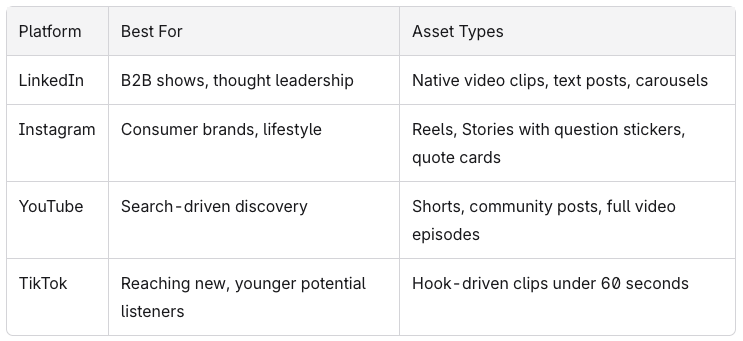
Most hosts underuse social media by posting one generic announcement and moving on. Agencies leverage social media for podcast promotion and engagement through a structured, multi-touch approach that treats each episode as weeks of content, not a single post.
Multi-Touch Distribution Plan
For each episode, plan 4–8 posts across 1–3 priority social platforms:
Standalone Value
Write posts that deliver value even if the reader never clicks play. A standalone insight, a surprising statistic, or a framework graphic gives non-listeners something useful and makes them more likely to subscribe. Social media promotion done well functions as both awareness and audience engagement simultaneously.
Coordination with Campaigns
Coordinate with the wider marketing team so podcast clips support current launches, events, or campaigns. If your company is running a product launch, the episode featuring that topic should surface across all social platforms during the same window. Podcast marketing can increase listener engagement by 93% when distribution is consistent and relevant, not random.
Guest & Host Promotion: Multiplying Reach Without Buying Listeners
Guest appearances are one of the most powerful organic audience growth levers for any podcast. Podcast guesting allows shows to borrow audiences from established podcasts and networks, and agencies provide access to expansive networks within the podcasting industry to facilitate this.
Equipping Guests
Before the episode goes live, send each guest a media kit containing:
- 2–3 short video clips and quote graphics
- Pre-written social posts they can customize
- Easy share links for Apple Podcasts, Spotify, and YouTube
Set expectations during booking: agree that guests will share the episode with their newsletter or social audience on release day. ThePod.fm's data shows that roughly 7.5% of podcast guest invitations result in booked intro calls with decision-makers, nearly 47× the conversion rate of cold email at 0.16%. New guest outreach, done strategically, is both a content and a pipeline play.
Strategic Guest Selection
Choose guests whose audiences overlap with your ICP rather than chasing big names with mismatched followers. A guest with 3,000 niche LinkedIn followers in your industry often drives more right listeners than a celebrity with a million followers in an unrelated space. Guest outreach should prioritize relevance over fame.
Host Amplification
The host's personal LinkedIn, X account, and email signature are underused podcast marketing surfaces. Hosts should post teaser clips, behind-the-scenes content, and personal commentary. These channels already carry trust, which makes them high-conversion for building new subscribers.
Track guest-driven impact using custom URLs, UTM parameters, or referral questions in lead forms to understand which guest appearances drive the most valuable traffic.
Paid Podcast Advertising and Cross-Promotion-Used the Right Way
There are no safe guarantees of "viral" growth. Masterly Studios avoids bought or low-quality listeners because inflated downloads with no engagement produce zero business value. That said, targeted paid media campaigns can significantly boost podcast visibility when used at the right stage.
Sensible Paid Tactics
Podcast promotion companies use paid placements and organic distribution in combination. Effective paid options include:
- In app advertising on listening platforms like Spotify and Apple Podcasts
- Feed swaps and promo drops with complementary shows your audience already trusts
- Premium placements in niche podcast networks relevant to your specific niche
Cross promotions with content allies-shows that share your ICP but are not direct competitors-can help grow authority and expand audience reach. Using audience targeting options allows targeted podcast advertising with precise targeting, so your budget reaches potential listeners, not random ears. 78% of agencies and brands currently advertise in podcasts, making targeted advertising campaigns a normalized part of the media mix.
When Paid Makes Sense
Paid campaigns work after your show has clear positioning, consistent content cadence, and a validated audience. Running paid media before product-market fit is premature and wasteful. Test small first, then scale based on cost per engaged listener or cost per qualified lead, not vanity download counts.
Note the distinction between podcast advertising for your own show versus using your show as a channel to advertise products to existing listeners. Both are valid; they require different strategies and budgets. Strategic promotion combined with earned media through editorial features and influencer partnerships creates a more durable growth engine than paid campaigns alone.
Performance Analytics: Turning Episodes into a Learning Loop
Podcast marketing services must include ongoing performance analytics, not just asset creation. Utilizing analytics is crucial for optimizing podcast marketing strategies, and agencies use analytics tools to measure podcast performance across every channel. Podcast marketing agencies use analytics to measure campaign success and continuously improve results.
Key Metrics
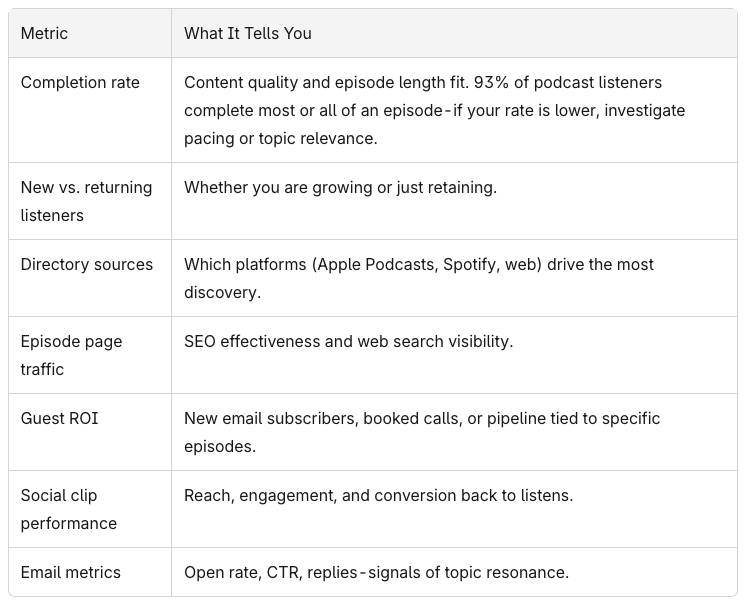
Tying Analytics to Business Outcomes
Where possible, connect podcast exposure to business data: demo requests, leads, or sales that mention specific podcast episodes. Use landing pages, unique UTMs, or promo codes. Advanced analytics should inform whether you allocate more resources to email, social, or paid in-app ads.
Review Rhythm
Monthly tracking catches immediate issues like a sudden drop in downloads or completion rate. Quarterly strategy reviews-aligned with business campaign cycles-allow you to adjust themes, guest strategy, and resource allocation based on data rather than gut feel. Podcast marketing agencies provide tailored audience growth strategies precisely because they build these review loops into their services provided.
How Masterly Studios Structures Ongoing Podcast Marketing Services
As a podcast production agency and podcast agency built for professional hosts, Masterly Studios structures services around a repeatable engagement model rather than one-time deliverables. We function as a full service podcast agency that integrates into your existing marketing operations.
End-to-End Service Structure
- Strategy Workshop - ICP identification, audience mapping, positioning, content themes, and platform selection tailored to your podcast's visibility goals.
- Content Calendar - Monthly topic planning, guest calendar built around strategic outreach, planned clips, and SEO themes.
- Production Handoff - Coordinating with your podcast hosting platform and editing team to ensure clip-friendly segments and chaptered content.
- Distribution Checklist - Asset creation, metadata optimization via your RSS feed, social and promotional scheduling, email triggers, and a podcast media list for earned media outreach.
- Monthly Performance Review - Combined analytics across PSO, social, email, and guest ROI using advanced analytics dashboards.
- Quarterly Strategy Refresh - Adjustments based on business campaigns, data trends, and audience feedback. We review client testimonials, listener surveys, and downstream revenue data.
Collaboration with Your Team
Masterly Studios integrates with existing CRM systems for list segmentation, connects with sales teams for lead quality feedback, and works with brand teams on visual identity. We treat your podcast growth as a shared objective, not an isolated project. We have a proven track record of helping hosts in a crowded space build brand awareness and generate a more qualified pipeline from their shows. Podcast marketing agencies that operate this way deliver compounding returns over time, not vanishing spikes.
Build a Podcast Marketing Plan - let us design one for your show's stage, audience, and goals.
Putting It All Together: A Repeatable Distribution Plan for Every Episode
Effective podcast marketing often combines multiple promotional channels for growth. Here is what a complete distribution checklist looks like for one episode, from recording day to 30 days after release:
- Recording day: Mark clip timestamps, capture behind-the-scenes content for social
- Editing phase: Finalize transcript, create 4–6 short-form clips, write show notes and blog summary
- Release day: Publish across all platforms, send episode email, post first social clip, notify guest with media kit
- Days 2–7: Roll out remaining clips across social platforms, host posts personal commentary, guest shares to their audience
- Days 8–30: Publish blog post, repurpose into carousel or newsletter feature, monitor analytics and adjust promotion strategies
- Months 6–12: Resurface high-performing episodes with refreshed clips or updated intros for new listeners
Treat each episode as a long-term asset. The best shows revisit and resurface strong content, pulling indie creators and established hosts alike out of the publish-and-forget cycle. Sustainable podcast audience development comes from consistent, high-quality marketing services and continuous improvement-not one-time stunts or strategic promotion that stops after launch week.
Whether you are building a show for content creation, recruiting, or revenue, the system outlined here applies. The key is consistency and measurement.
Contact Masterly Studios to Build a Podcast Marketing Plan tailored to your show, your right audience, and your business goals. We work with serious, professional hosts and brands ready to turn their podcast into a growth engine.