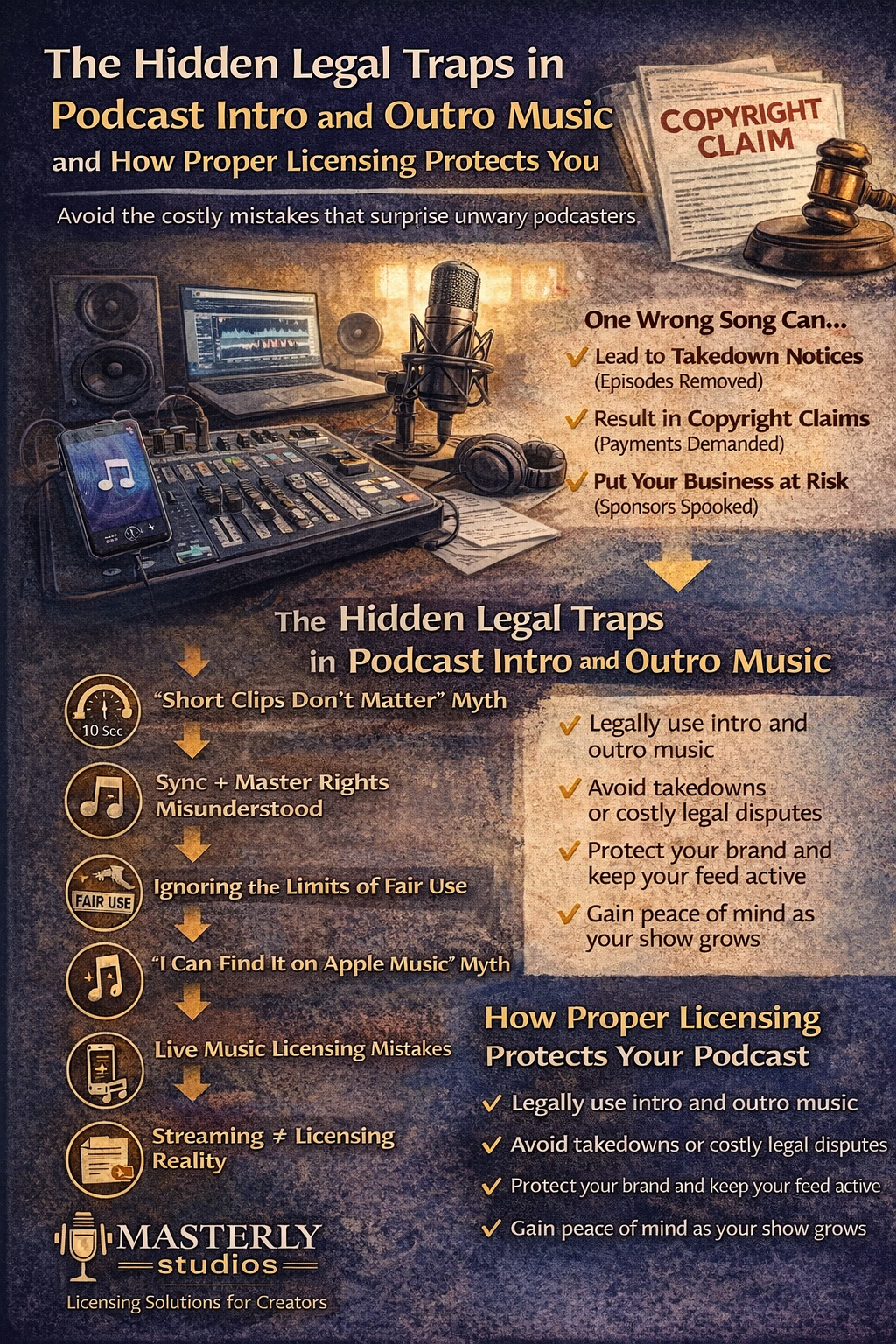
The Hidden Legal Traps in Podcast Intro and Outro Music and How Proper Licensing Protects You
February 11, 2026
There’s a moment in every great podcast where the intro hits and the listener instantly knows what kind of experience they’re about to have. The beat sets the mood, the sound feels polished, and the show suddenly has an identity. For podcasters, that short musical clip can feel like a harmless detail—just a few seconds to make the episode feel modern, memorable, and professional. But in music and copyright law, “just a few seconds” can still create serious consequences.
At Masterly Studios, we work with creators across the country who want their podcasting brand to grow without stepping into legal landmines. We’ve seen the same pattern again and again: a podcaster chooses the perfect song, uses it as intro music or outro music, and assumes it’s fine because the clip is short. Then the show gets flagged, removed, or hit with a claim that costs time, money, and momentum. This article breaks down the hidden traps in music licensing, why short clips still matter, and how the right podcast music license can protect your business before a small mistake turns into a big problem.
Many creators assume they’re too small to be noticed. But the internet is automated, and copyright owner enforcement is often handled by systems that detect sound instantly. Your podcast may only have a few hundred listeners today, but one viral clip can put you on the radar overnight. When your show grows, old episodes with unlicensed music become a risk you carry forward.
The issue is not just how long the music plays. The issue is whether you had permission and the correct license. A short clip can still be recognizable, and recognition is exactly what detection systems are built for. The moment a listener can hear the song clearly, the risk becomes real.
This is where creators get trapped. They might obtain a license for one side but forget the other. Or they purchase something that sounds official but doesn’t cover their usage. If your podcast uses the master recording of a copyrighted song, you must have the right approvals in place.
This is why “I paid for it” doesn’t always protect you. The form of the license matters, the language matters, and the scope matters. If you want the right music long-term, you need licensing that matches how your podcast will be distributed. That includes streaming platforms, social media snippets, and promotional clips.
Sync license requirements can apply even when the music is short. If the clip is paired with your brand, your intro, or your voiceover, it is still synced. In the industry, that is a big deal. A sync license is one of the key tools that protects you when your podcast grows beyond audio.
When you use a recognizable song as your intro, you’re not just playing music. You’re creating a signature sound that can be traced, clipped, shared, and reposted. The more your listeners hear it, the more likely it becomes discoverable. That is why licensing matters even more for intros and outros than for a one-time sound effect.
In most cases, using a song as intro music is not fair use. Using outro music to make your show feel more professional is not fair use. Even if you talk over the music, fair use is still not guaranteed. Parody can sometimes qualify, but parody has a specific meaning, and simply being funny does not always count.
Fair use can be real, but it is risky to rely on it for branding. If your podcast is a business, fair use arguments become even harder. That’s why proper music licensing is the safer path.
Just because a song is easy to download, easy to find, or easy to play doesn’t mean it’s legal to include in your podcast. The copyright owner still controls reproduction, distribution, and public performance rights. If you build your podcast around a track you found on a streaming platform, you may be building your brand on borrowed property.
Even a short live clip can be detected. If your audience can hear the melody clearly, the track may be identified. This is why podcasters need to be mindful when recording at events, in restaurants, or during live shows. The safest move is to control your recording environment whenever possible.
Even if the claim is resolved, the damage can be real. Your episode might lose momentum, your audience may miss content, and your brand can look unreliable. If you run ads or sponsorships, you can also lose business opportunities. A short clip can create long-term consequences.
This is why licensing should happen before publishing. It’s far easier to obtain permission upfront than to negotiate after a violation. Once your content is out in the world, the evidence is already public. And once the internet has copied it, it’s hard to fully erase.
Licensing also helps you monetize safely. Sponsors want professionalism, and they don’t want legal drama. Platforms want compliant content, and they will protect themselves first. When you have the right license in place, you protect your podcast and your business at the same time.
But the perfect song is not worth losing your show. The right choice is music you can legally use, repeatedly, without worry. The best intro is one you can keep forever. A cost effective approach is to choose properly licensed tracks or commission custom music.
The key is documentation. You should be able to show what you obtained, what it covers, and where it applies. Your license should match your distribution plan, including clips, trailers, and promotional content.
At Masterly Studios, we work with creators across the country who want their podcasting brand to grow without stepping into legal landmines. We’ve seen the same pattern again and again: a podcaster chooses the perfect song, uses it as intro music or outro music, and assumes it’s fine because the clip is short. Then the show gets flagged, removed, or hit with a claim that costs time, money, and momentum. This article breaks down the hidden traps in music licensing, why short clips still matter, and how the right podcast music license can protect your business before a small mistake turns into a big problem.
Why Podcast Music Creates Bigger Risk Than Most Creators Expect
Podcast music is not treated like casual background noise, even if it feels that way. In most cases, music is considered intellectual property, and it is protected by copyright laws the moment it is created and recorded. That means copyrighted music isn’t “free” just because you found it online, heard it on social media, or can stream it on apple music. The law cares about rights holders, permissions, and the exact usage of the track.Many creators assume they’re too small to be noticed. But the internet is automated, and copyright owner enforcement is often handled by systems that detect sound instantly. Your podcast may only have a few hundred listeners today, but one viral clip can put you on the radar overnight. When your show grows, old episodes with unlicensed music become a risk you carry forward.
The “It’s Only 10 Seconds” Myth and Why It Fails
One of the most common misconceptions is that you can play music for a brief time and it won’t matter. Unfortunately, copyright laws don’t have a magic “safe” timer that makes copyrighted songs legal after a few seconds. Even a short intro or outro can trigger copyright infringement claims if the music wasn’t properly licensed. This is why creators get surprised when they receive takedown notices for a clip they assumed was too small to matter.The issue is not just how long the music plays. The issue is whether you had permission and the correct license. A short clip can still be recognizable, and recognition is exactly what detection systems are built for. The moment a listener can hear the song clearly, the risk becomes real.
Understanding the Two Rights in Every Recording
When you use music in a podcast, you’re usually dealing with two separate rights. One right is the composition (the song itself), often controlled by music publishers or publishers working with songwriters and composers. The second right is the master recording, which is often controlled by a record label or the artist, depending on the deal. To legally use most commercial music, you typically need permission for both.This is where creators get trapped. They might obtain a license for one side but forget the other. Or they purchase something that sounds official but doesn’t cover their usage. If your podcast uses the master recording of a copyrighted song, you must have the right approvals in place.
What a Podcast Music License Actually Covers
A podcast music license is not one-size-fits-all. It can cover different platforms, different distribution methods, and different types of use. A license might cover one episode but not a full catalog. It might cover audio-only but not visuals if you post video clips. It might cover background use but not a featured intro.This is why “I paid for it” doesn’t always protect you. The form of the license matters, the language matters, and the scope matters. If you want the right music long-term, you need licensing that matches how your podcast will be distributed. That includes streaming platforms, social media snippets, and promotional clips.
Why Sync License Rules Confuse Podcasters
A sync license is one of the most misunderstood parts of music licensing. People often think sync licenses are only for movies, commercials, or YouTube videos. But if you are syncing music to content that is distributed and monetized, a sync license can become relevant—especially when you add visuals or publish video episodes. Many podcasters now record video and post clips, which creates additional licensing exposure.Sync license requirements can apply even when the music is short. If the clip is paired with your brand, your intro, or your voiceover, it is still synced. In the industry, that is a big deal. A sync license is one of the key tools that protects you when your podcast grows beyond audio.
Intro Music and Outro Music Are Branding, Not “Background”
Intro music is not just filler—it’s brand identity. Outro music is not just an ending—it’s the final impression that stays with listeners. Because intros and outros are repeated, they create a stronger association between the track and your podcast. That repeated use can make the music feel like part of your business, and rights holders pay attention to that.When you use a recognizable song as your intro, you’re not just playing music. You’re creating a signature sound that can be traced, clipped, shared, and reposted. The more your listeners hear it, the more likely it becomes discoverable. That is why licensing matters even more for intros and outros than for a one-time sound effect.
The Fair Use Trap: Why It Rarely Protects Podcast Music
Fair use is one of the most abused phrases in podcasting. Many creators assume fair use covers any short clip, any commentary, or any “educational” intent. But fair use is not automatic, and it’s not a permission slip. It’s a legal defense that depends on context, purpose, amount used, and market impact.In most cases, using a song as intro music is not fair use. Using outro music to make your show feel more professional is not fair use. Even if you talk over the music, fair use is still not guaranteed. Parody can sometimes qualify, but parody has a specific meaning, and simply being funny does not always count.
Fair use can be real, but it is risky to rely on it for branding. If your podcast is a business, fair use arguments become even harder. That’s why proper music licensing is the safer path.
“But It’s On Apple Music” Doesn’t Mean You Can Use It
Streaming access is not licensing access. Apple music lets a user listen, not reuse. When you stream a track, you’re not receiving the right to publish it inside your own content. This is a critical misunderstanding that causes creators to get flagged.Just because a song is easy to download, easy to find, or easy to play doesn’t mean it’s legal to include in your podcast. The copyright owner still controls reproduction, distribution, and public performance rights. If you build your podcast around a track you found on a streaming platform, you may be building your brand on borrowed property.
Live Music in Podcasts Can Still Require Licensing
Some podcasters assume live music is “different” because it’s spontaneous or recorded in a real-world environment. But live music can still be copyrighted music, and it can still trigger claims. If a musician performs a cover, the composition is still owned by someone. If a venue plays copyrighted songs in the background, it can still appear in your recording.Even a short live clip can be detected. If your audience can hear the melody clearly, the track may be identified. This is why podcasters need to be mindful when recording at events, in restaurants, or during live shows. The safest move is to control your recording environment whenever possible.
How Copyright Infringement Claims Can Hit Your Podcast Overnight
Copyright infringement claims can show up in ways that feel sudden. One day your episode is live, and the next day it’s muted, removed, or restricted. You might receive an email from a platform, a warning from a distributor, or a claim from a rights holder. Some creators also receive direct demands from a record label or legal representatives.Even if the claim is resolved, the damage can be real. Your episode might lose momentum, your audience may miss content, and your brand can look unreliable. If you run ads or sponsorships, you can also lose business opportunities. A short clip can create long-term consequences.
What Happens When a Record Label or Publisher Gets Involved
When a record label gets involved, things can become serious fast. Labels often have teams and systems designed to protect their master recording rights. Music publishers also protect the composition rights, and they can enforce licensing requirements. Once the rights holders engage, the process can shift from a simple takedown to a legal demand.This is why licensing should happen before publishing. It’s far easier to obtain permission upfront than to negotiate after a violation. Once your content is out in the world, the evidence is already public. And once the internet has copied it, it’s hard to fully erase.
How Proper Licensing Protects Your Podcast Long-Term
Proper licensing is not just about avoiding trouble—it’s about building a stable brand. When you license music correctly, you can publish confidently, repurpose content, and scale your show without fear. Your intro becomes a real asset, not a ticking time bomb. Your outro becomes part of your identity, not a risk.Licensing also helps you monetize safely. Sponsors want professionalism, and they don’t want legal drama. Platforms want compliant content, and they will protect themselves first. When you have the right license in place, you protect your podcast and your business at the same time.
Choosing the Perfect Song Without Choosing the Wrong Risk
Every creator wants the perfect song. You want something upbeat, catchy, and memorable. You want the tone to match your voice, your topic, and your audience. That’s normal, and music is a powerful form of art that connects instantly.But the perfect song is not worth losing your show. The right choice is music you can legally use, repeatedly, without worry. The best intro is one you can keep forever. A cost effective approach is to choose properly licensed tracks or commission custom music.
Practical Ways Podcasters Can License Music Safely
Here are common options that can protect your podcast while keeping your sound professional:- Use royalty-free music with a clear commercial license
- Purchase a track bundle designed for podcasting usage
- Commission an artist to create a custom intro and outro
- Work with musicians who provide written permission and terms
- Obtain a sync license and master recording permissions when needed
The key is documentation. You should be able to show what you obtained, what it covers, and where it applies. Your license should match your distribution plan, including clips, trailers, and promotional content.
Why Licensing Needs to Match Your Podcast’s Growth Plan
Many podcasters start small and then scale quickly. You might begin with audio-only episodes and later add video. You might create reels, shorts, and promotional visuals. You might expand to live events or sell products. All of that changes the licensing needs.This is why licensing should be treated like a business decision, not an afterthought. Your podcast is a project that can grow into a brand. The music you choose should be safe for that future. When licensing is done correctly, your catalog stays usable without constant re-editing.
The Masterly Studios Approach to Protecting Creators
At Masterly Studios, we support podcasters who want to create confidently. We understand the industry and how quickly content spreads across platforms. Our team helps creators build professional sound, consistent branding, and content workflows that don’t collapse under legal pressure. We believe creators should focus on storytelling, not stress.We also understand that licensing is confusing for many podcasters. The words sound technical, and the rules feel inconsistent. That’s why we emphasize clarity: what you can use, what you can’t, and what you should obtain before you publish. When your music is licensed correctly, your podcast can grow safely in a world that moves fast.
Contact Masterly Studios for a Free Consultation
If you’re building a podcast and want to protect your brand from avoidable copyright problems, now is the best time to tighten up your music st rategy. Whether you’re using intro music, outro music, live music, or short clips you think are “fair,” the safest path is proper music licensing that matches your real usage. A few seconds of copyrighted music can still trigger claims, takedowns, or legal disputes that disrupt your show and your business.At Masterly Studios, we work with clients throughout the country and nationally, helping podcasters create professional content with confidence. If you want help selecting the right music, understanding licensing basics, and avoiding copyright traps tied to music and copyright law, we’re here to support you.
Call (888) 209-4055 to book a free consultation and let’s m ake sure your podcast sound is memorable for the right reasons.
Plan your Atlanta event space rental with the right room size, guest flow, technical support, and scheduling. Request a venue tour to confirm the best fit.
Explore what to consider when choosing Atlanta corporate event space, including room layouts, AV capabilities, parking, guest experience, and booking options.
Need a podcast lighting setup? Masterly Studios provides professional podcast and camera lighting in a prepared studio for consistent, polished video production.
Need a podcast studio setup? Masterly Studios offers a professional recording space with quality equipment, lighting, acoustics, and video support for creators.
Book a training venue in Atlanta for corporate workshops, employee training, and learning events with flexible layouts, A/V support, and professional amenities.
Learn how to record a video podcast in Atlanta with a professional studio setup, clear audio, polished lighting, guest support, and a smooth recording workflow.
Book a corporate Christmas party venue in Atlanta for year-end events with flexible space, A/V support, catering, branding, and more for your team and festive fun.
Book a creative studio rental for photography, video, branded content, and marketing campaigns with flexible production space at Masterly Studios for every project.
Book a professional seminar venue for training, presentations, and business events with flexible seating, A/V, check-in, parking, content support, and event setup.
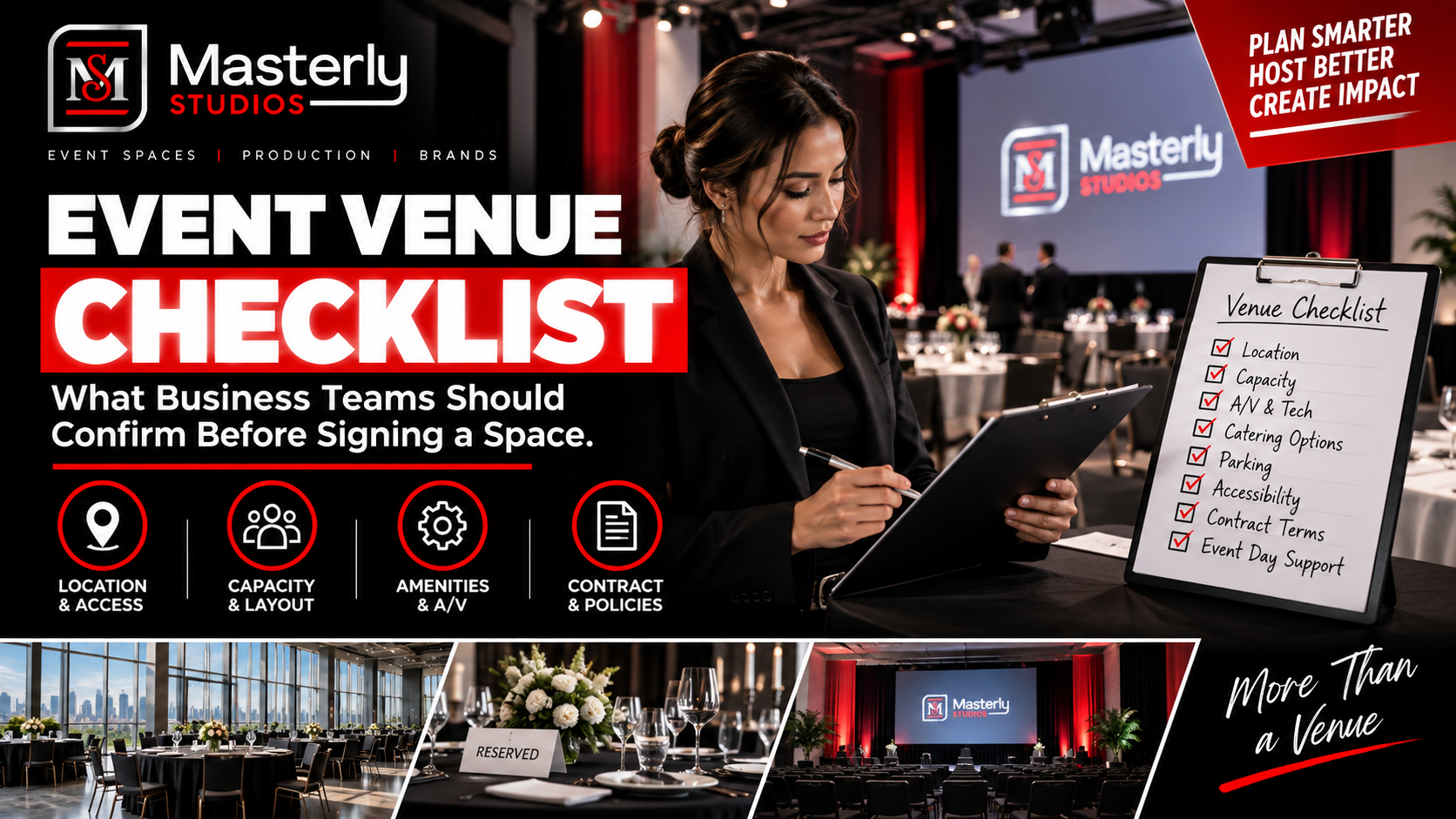
Use an event venue checklist to evaluate capacity, layout, parking, load-in, A/V, Wi-Fi, accessibility, catering, branding, production, and overtime needs.