Cyc Wall: What a Cyclorama Wall Is and How Studios Use One
A cyc wall, short for cyclorama wall, is a studio wall with a curved cove where the floor meets the wall, and sometimes where two walls meet, so the corner disappears on camera. Lit evenly, a cyc wall creates a seamless background with no visible horizon line, which is why photographers and video crews call it an infinity wall or endless background. Cyc walls are used for product photography, portraits, fashion, commercial video, interviews, and green screen work.
This guide explains what a cyc wall is, how it differs from a paper backdrop or flat wall, the main types and colors, how a cyclorama wall is built and maintained, and how to plan a shoot on one.
What Is a Cyc Wall?
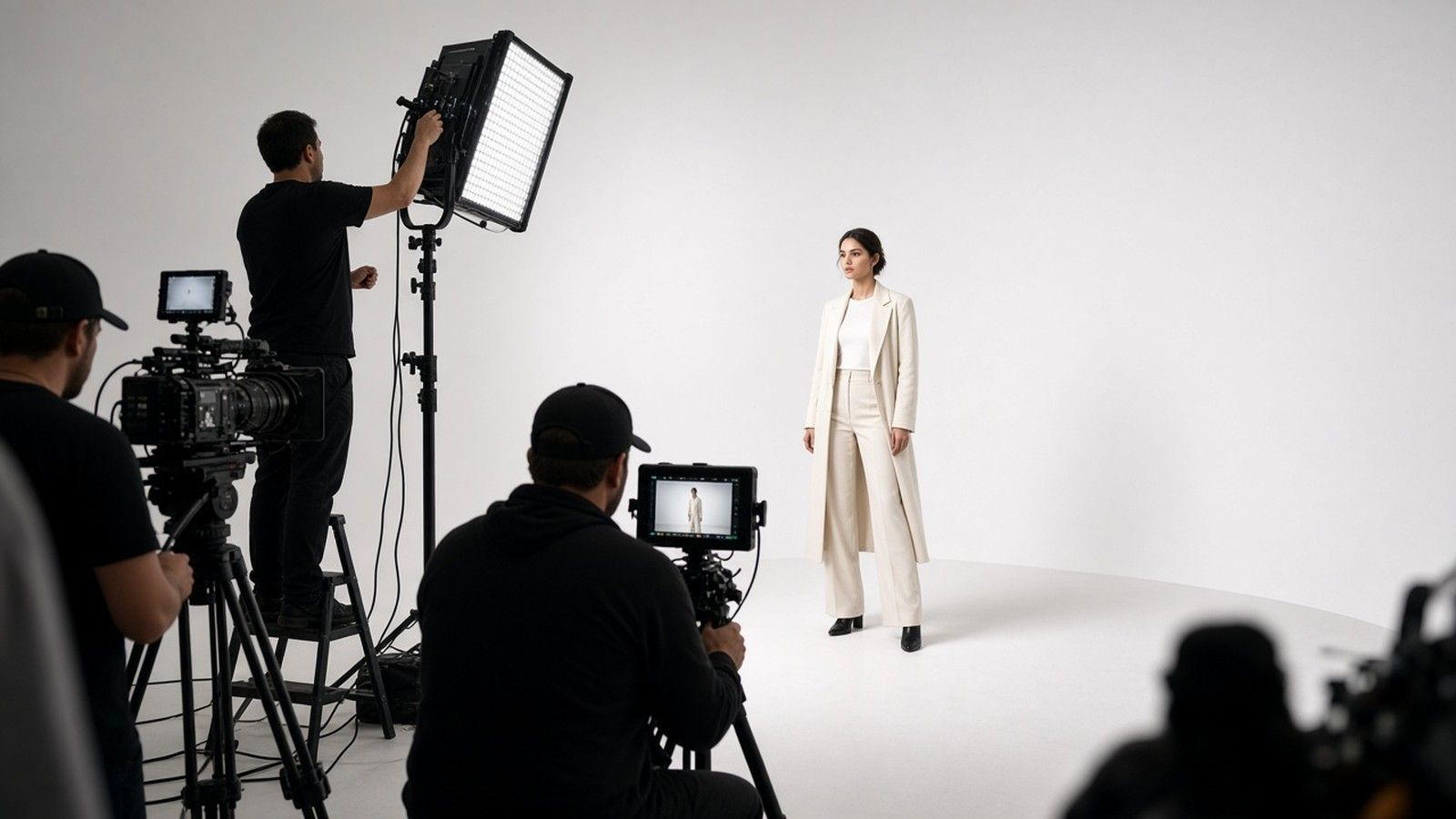
The defining feature is the cove: a radius that replaces a sharp floor-to-wall intersection. When framing and lighting conceal that radius, the picture can appear to continue beyond the room. Some systems also curve around wall corners or toward the ceiling. A white finish supports clean-background photography; green or blue finishes support background replacement ( Pro Cyc, Cyclorama Walls: What They Are and When to Use Them).
An infinity effect is an image result, not a guarantee that every camera angle will work. A lens can still reveal the outer edge of the structure, and uneven illumination can make the cove visible. Plan the infinity wall around the intended frame, not simply the largest area available in the room.
Terms you will see used for the same thing include:
- Cyc wall or cyc
- Cyclorama wall
- Infinity wall or infinity cove
- Endless background or seamless background wall
Why Studios Use a Cyc Wall
Painting adjoining surfaces the same color does not remove their geometry. A hard corner can remain visible through a change in illumination. Replacing it with a gradual curve gives the crew a transition to light rather than a sharp boundary to hide. Pro Cyc identifies this geometry as a reason to use a cyclorama wall, particularly when uneven green or blue backgrounds would complicate keying.
That gives production teams several advantages:
- Wide and full body shots. Talent can stand on the floor and the camera can shoot wide without showing a corner, provided the structure covers the full shot.
- Movement. Dancers, athletes, and models can move across a large smooth surface instead of a narrow strip of paper.
- Large products. Cars, furniture, and equipment can sit on the cyc floor for clean product photography on pure white.
- Clean keying. On a green screen cyc, an even, shadow-free surface makes the chroma key easier in post production.
- Consistency. A fixed cyc wall gives recurring productions a background they can document and return to. Record lighting positions and exposure as well as the wall color.
Cyc Wall vs. Paper Backdrop vs. Flat Wall
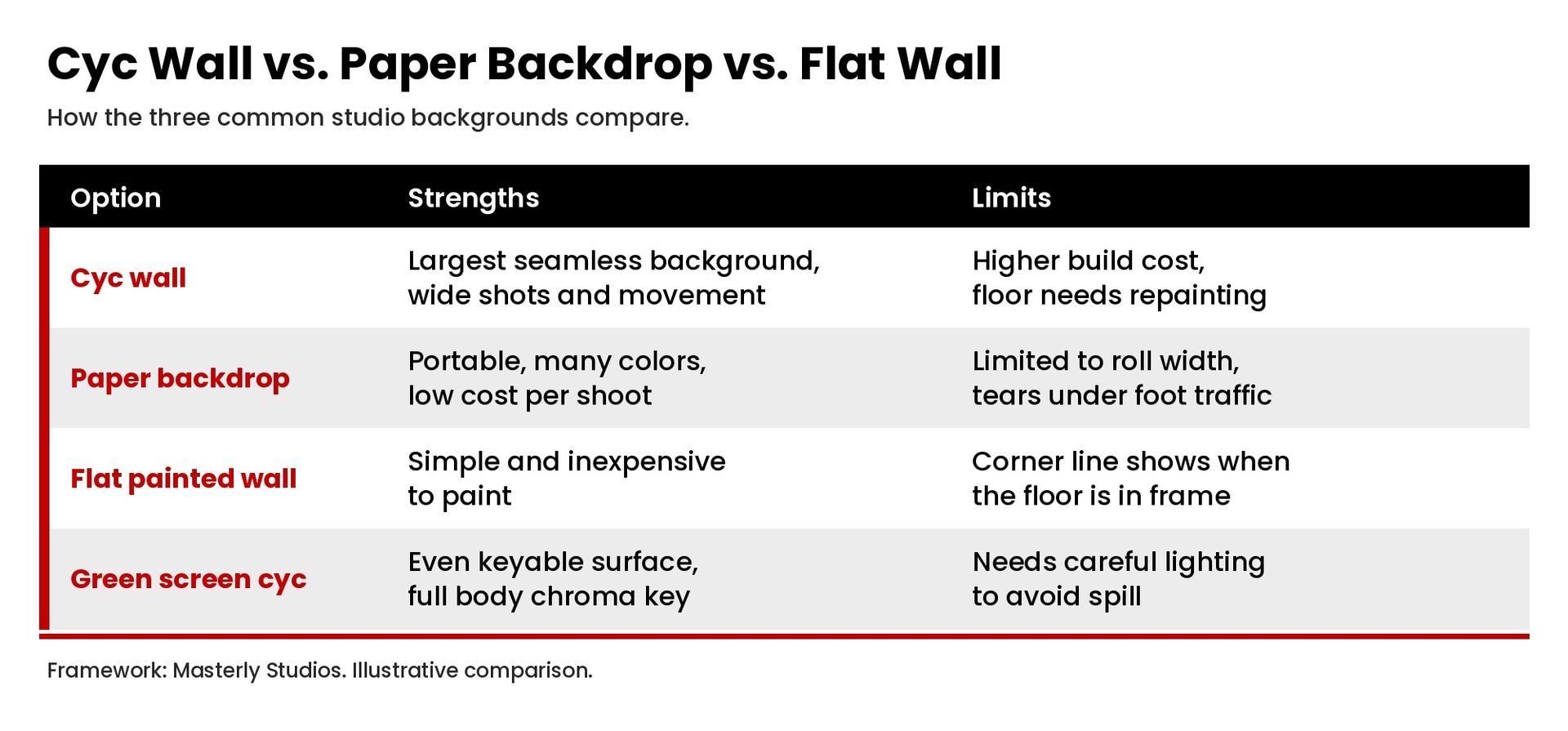
A seamless paper backdrop is portable, inexpensive per shoot, and available in many colors, but it is usually limited to the width of the roll and tears or wrinkles when people walk on it. Our guide to seamless paper backdrops covers when paper is the better choice. A flat painted wall is the simplest option but shows a corner line in any shot that includes the floor. A cyc wall costs more to build and maintain but can provide a broad continuous background and more framing and movement options when its dimensions suit the shot.
Types of Cyc Walls: White Cyc, Black Cyc, and Green Screen
White cyc
A white cyc is the most common type. Painted white and lit evenly, it can be pushed to pure white for ecommerce and fashion work, or lit with less light for a soft gray. Many studios use a white cyc for headshots, product photography, music videos, and commercial video.
Black cyc
A black cyc absorbs light and creates a dark, dramatic background. It is used for moody portraits, product reveals, and high contrast video.
Green screen cyc in chroma key green
A green screen cyc wall is painted chroma key green (or blue) so editors can replace the background with graphics, sets, or other footage. Because keying depends on even color values, a cyclorama curve matters even more here than on a white cyc. If your production depends on keying, see our guide to podcast and video lighting setup for lighting principles that also apply to green screen work.
Corner and multi wall cycs
A one wall cyc has a single curved floor cove. A two or three wall cyc adds curved corners between walls, which allows the camera to shoot from more angles. Some large studios add a ceiling cove as well.
How a Cyclorama Wall Is Built
A cyclorama wall can be built in place or installed from a kit. The main approaches are:
- Built in place. A custom approach can use wood ribs and a sheet covering, followed by joint finishing and sanding. Peerspace describes plywood ribs and Masonite covering in its example below. This is common in a permanent studio.
- Cyc wall kit. Prefabricated cove sections made from fiberglass, steel, or other materials attach to existing walls and floors, then are finished and painted. A kit is faster to install and gives a consistent curve.
- Freestanding systems. Some systems stand on their own frame instead of attaching to the building, which is useful in rented spaces where a studio owner cannot change the walls.
The size of the cove radius affects the result. A larger, gentler curve is easier to light evenly and hides the transition better, but it takes up more floor space. Pro Cyc notes that larger coves are more forgiving for green screen and blue screen work, while smaller coves can still work well for a white cyc because extra light hides transition shadows more easily ( Pro Cyc). Before you build, make sure the room has enough room for the cyc, the camera distance, and the lights, as well as enough ceiling height for overhead lighting.
Cyc Wall Kit vs. Custom Build
A studio owner deciding how to build a new cyc usually compares a cyc wall kit with a custom build by carpenters.
- Speed. A kit arrives with the curves already formed, so installation is usually faster. A custom build in drywall and wood takes longer because every joint must be filled, sanded, and checked.
- Consistency. Kit sections are made to the same radius, so the curve is uniform across the whole infinity wall. A custom curve depends on the skill of the crew.
- Flexibility. Ask an installer how either approach would handle columns, windows, an uneven floor, and other room constraints. Do not assume a kit will fit without a measured plan.
- Permanence. Both can be part of a permanent studio. Some kits can be taken apart and moved, which matters if the studio may relocate.
How Much Does a Cyc Wall Cost?
The cost of a cyclorama wall depends on size, materials, number of corners, labor, and finish, so there is no single price. The main factors are:
- Size of the wall. A wider and taller cyc wall needs more materials and more labor. Ceiling height also matters if you plan a ceiling cove.
- Number of walls. A one wall cyc costs less than a two or three wall cyc with curved corners.
- Kit or custom. A cyc wall kit has a known material cost, while a custom build depends on local labor rates.
- Finish and paint. Professional finishing, primer, and specialty paint such as chroma key green add to the total, and repainting is an ongoing cost.
- Lighting. A cyc wall needs lighting for the background as well as the subject, which is often a large part of the budget.
For a business that only needs a cyc wall for a few projects a year, renting time in a studio that already has one is often more practical than building one.
Can You Build a Cyc Wall Yourself?
A do it yourself cyclorama is a construction project, not simply a paint treatment. The outline below follows the general sequence in the Peerspace guide linked below. Have a qualified installer evaluate attachment methods, material suitability, and the room before deciding to build. The broad stages are:
- Plan the space. Measure the room and decide on the width, depth, and curve. Leave enough room behind the camera and above the set for lights.
- Frame the curve. Cut curved wood ribs, fix them to the wall and floor, and space them closely enough to support the surface.
- Cover the frame. Select a covering suited to the designed radius; the Peerspace example uses Masonite over supporting ribs.
- Fill and sand. Tape and mud every seam, then sand until the surface is smooth. Any bump or ridge will catch light and show on camera.
- Prime and paint. Prime the surface, then paint it white, gray, black, or chroma key green with a matte finish.
- Test with lights. Light the cyc wall and shoot test frames to find seams or hot spots before the first real job.
For scale, a Peerspace build guide for a full body photo and video cyc wall uses three foot curves, a 12 foot high wall, and 18 feet of bare floor, built from plywood ribs, dowels, and quarter inch Masonite finished with drywall mud, white floor primer, and flat white or chroma key green paint ( Peerspace, How to Build a Cyc Wall). For smaller product photography, the same guide suggests a tabletop cyclorama or seamless paper instead of a full build.
During review of a first build, check for a curve that is too tight, visible seams at the joints, and a floor that is not level.
Using a Cyc Wall for Video and Film
A cyc wall is not only for still photography. Video and film crews use a cyclorama for interviews, commercials, music videos, training content, and talking head videos because the background stays clean even when the camera moves. For a business producing a series of videos, the same cyc gives a consistent look from one episode to the next. If you are planning recurring content, our guide to training video production explains how to plan a series before the first shoot.
On a green screen cyc wall, the crew can film full body shots and then place the talent in a virtual set, a product environment, or branded graphics. Keep talent far enough from the wall to avoid green spill on hair and clothing, and light the green screen separately from the subject.
Questions Clients Should Ask Before Booking a Cyc Wall
Clients booking studio time for the first time often focus on the hourly rate. These questions help you compare studios on what affects the result:
- How wide, deep, and tall is the cyc wall, and how many walls does it cover?
- Is the cyc white, black, gray, or green, and can it be painted before my shoot?
- When was the floor last painted, and is there a repaint fee?
- What lighting and grip come with the booking, and is a technician available?
- Is there a loading door and a route for large products or sets?
Painting and Maintaining a Cyc Wall
Treat surface condition as a production variable. Inspect for marks from shoes, equipment, and furniture before lighting the background. Pro Cyc specifies a flat finish for its white studio paint and controlled-color paints for chroma key use. Ask the operator which finish is in place and what touch-up process applies to your booking.
Common maintenance tasks include:
- Repainting the floor and lower curve after heavy use
- Patching cracks at seams and joints in drywall or plaster
- Keeping shoe covers available for talent and crew
- Protecting the surface with mats when moving heavy equipment
When you book time on a cyc, ask whether the studio repaints before your session and whether a repaint fee applies after your shoot. Policies vary from studio to studio.
How to Light a Cyc Wall for Photo and Film
Lighting a cyc has two parts: the background and the subject.
- Light the cyc separately. Use soft, wide lights or overhead strips aimed at the wall to create an even background. For pure white, the background is usually lit brighter than the subject.
- Light the subject. Use a key light and fill on the talent or product, positioned so it does not spill unevenly onto the wall.
- Keep distance. Move the subject several feet away from the curve to reduce shadows and color spill, especially on a green screen.
- Check the frame. Look for hot spots, uneven gradients, and visible seams on the monitor before you start shooting.
Planning a Shoot on a Cyc Wall
Good planning makes a cyc booking efficient:
- Confirm the size. Ask for the width, depth, and height of the cyc, and whether it is a one wall or corner cyc.
- Confirm the color. Check whether the cyc is white, black, or green, and whether a color change is possible before your date.
- Plan the shot list. List full body, wide, and product images so the crew knows how much floor will be visible.
- Confirm equipment. Ask what lighting, grip, and power are included. Our photo studio rental page explains what to confirm when you book studio time.
- Plan load in. Large products, furniture, or sets need access, carts, and protection for the floor.
Frequently Asked Questions
What is a cyc wall used for?
A cyc wall is used to create a seamless background for photography and video. Common uses include product photography, fashion, portraits, music videos, commercial video, interviews, and green screen production.
What is the difference between a cyc wall and an infinity wall?
They are the same thing. Infinity wall describes the look of the background, while cyc wall or cyclorama wall describes the structure.
Is a cyc wall better than a green screen?
A green screen describes a keyable background; a cyc wall describes its shape. A green screen may be fabric, a portable sweep, or a painted wall. A curved green cyclorama can help reduce corner shadows, but it still needs controlled lighting.
How often is a cyc wall painted?
There is no universal repaint schedule. Ask the operator whether your booking includes a fresh coat, a touch-up, or the existing surface, and what marks trigger a repaint charge.
Book a Studio That Fits Your Production
A cyc wall gives photographers and video teams a clean, flexible background for wide shots, movement, and large products. When you compare studios, confirm the cyc size, color, lighting, and repaint policy before you book. To talk through the space and production support your project needs, see our video podcast and video production page or contact Masterly Studios.