Brand Activation: Types, Ideas, and How to Plan a Successful Campaign
A brand activation is a marketing campaign or live event that gets consumers to interact with a brand directly, instead of only seeing an ad. Product sampling, pop ups, immersive installations, live demos, and interactive digital experiences are all common types of brand activation. The goal is to create a real world moment that builds awareness, drives engagement, and moves customers closer to a purchase.
Brand activation sits close to experiential marketing and event marketing, and the terms often overlap. What makes an activation different from traditional advertising is direct engagement: the audience does something, such as tasting, trying, playing, sharing, or creating, and remembers the brand because of it. This guide explains what brand activation is, the main types of brand activation, how to plan a successful brand activation strategy, brand activation ideas, and how to measure success.

What Is Brand Activation?
Brand activation is the process of bringing a brand to life through an experience that prompts the target audience to take a specific action. That action might be trying a product, signing up, sharing on social media, or visiting a store. Brand activation campaigns can be physical, digital, or both, and they can take the form of a single event or a series of experiences, and they can support a launch, a rebrand, a seasonal push, or an ongoing relationship with customers.
A banner ad asks for attention. A brand activation asks for participation. That difference is why many marketers use activations when they need emotional impact, social sharing, or first party data that traditional marketing does not easily provide.
Brand activation vs. experiential marketing
Experiential marketing is the broader practice of marketing through experiences. Brand activation usually refers to a specific campaign or event within that practice, with defined marketing objectives and a defined audience. In everyday use, many teams use the terms interchangeably.
Why Brand Activation Matters
Brand activations give a brand presence in places where its customers already are. Done well, they:
- Build awareness with people who might ignore an ad.
- Create emotional resonance that makes a brand memorable.
- Drive engagement and social sharing , which extends reach beyond the people in the room.
- Generate first party data , such as sign ups and preferences, when guests opt in.
- Influence purchase decisions by letting people try a product before they buy.
- Generate press coverage when an activation is unusual or tied to a cultural moment.
For business to business brands, an activation can be a demo lounge at a trade show, a hands on workshop, or a private client event. A SaaS company, for example, might set up a live product demo area at a conference instead of only handing out brochures.
Types of Brand Activation
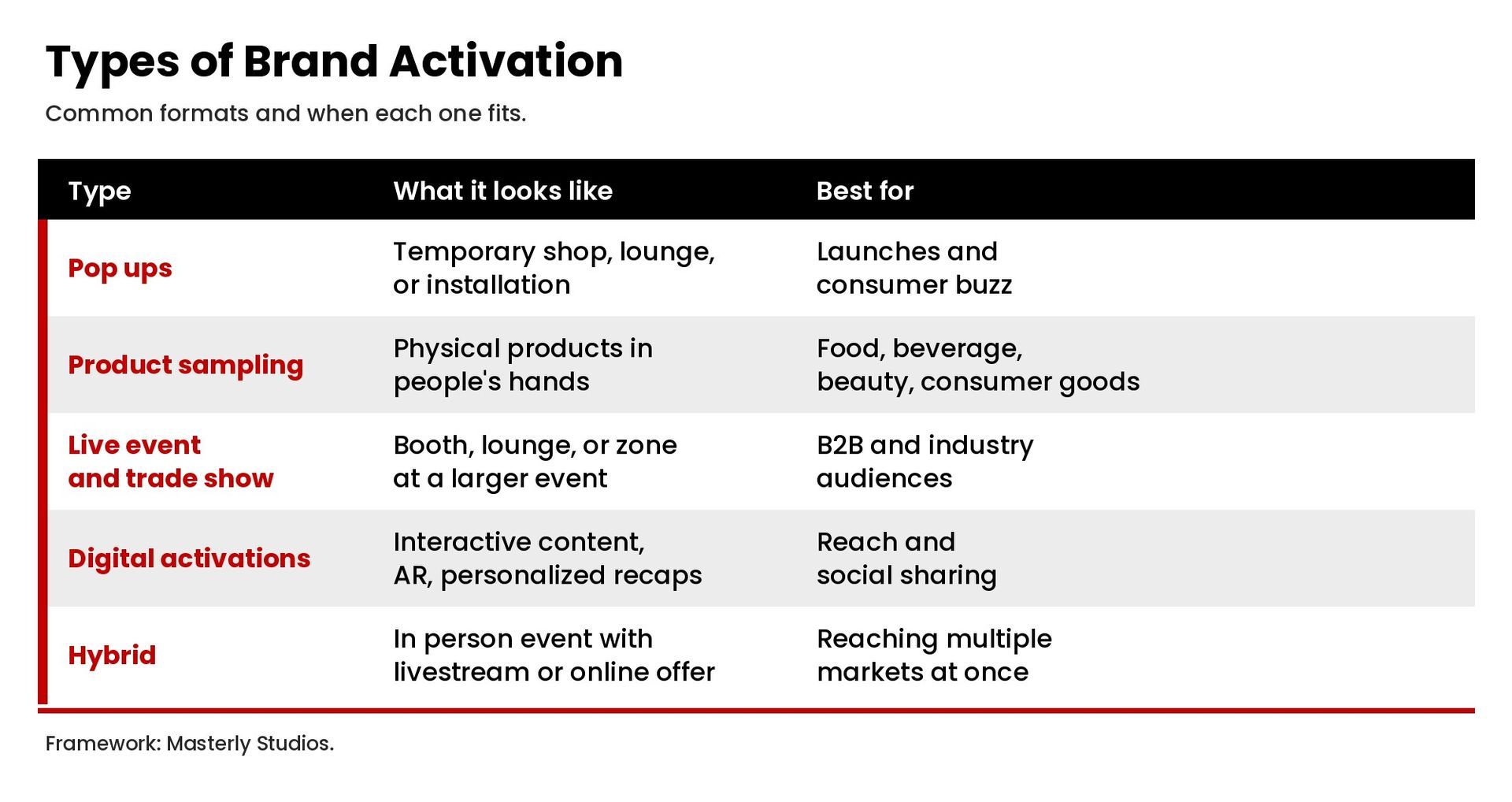
There are many types of brand activation. Most campaigns combine several.
Experiential events and pop ups
Pop ups are one of the most popular types of brand activation. Pop ups are temporary spaces, such as a shop, lounge, or installation, built for a short run. Pop ups create urgency because they are the only place, for a short time, to get a product or experience. Pop ups attract foot traffic, and give people a reason to visit in person. They range from a single room to custom builds that take over a large venue.
Product sampling
Product sampling puts physical products in people's hands. It is common for food, beverage, beauty, and consumer goods. Sampling works best when the setting matches how the product is used.
Live event and trade show activations
A live event activation is a branded experience at a larger event, such as a festival, conference, or trade show. At larger events, the brand builds a booth, lounge, or interactive zone that stands out from the general population of exhibitors.
Digital brand activations
Digital brand activations happen online, through interactive content, social challenges, filters, games, or personalized experiences. Augmented reality is one example, letting people place a product in their own room through a phone camera. Spotify Wrapped, the annual personalized recap of each user's listening, is a widely cited example of a digital activation that people share on their own.
Hybrid activations
Hybrid activations combine a physical experience with digital extension: a live event that is streamed, a pop up with a social sharing moment, or an in person demo that leads to an online offer. Livestreaming lets one activation reach multiple markets at once.
Cause and community activations
Some activations connect a brand to a community event, a cause, or a local partner. These work when the connection is genuine and the brand adds real value.
How Brand Activation Fits Your Marketing Strategy
Brand activation works best as part of a larger marketing strategy, not as a one off stunt. Experiential marketing campaigns reach consumers at a moment when they are paying attention, and the rest of your marketing can carry that moment forward. Before you commit to a format, ask how the activation will connect to the campaigns around it:
- Before the event: Use email, social media, paid digital campaigns, and partners to build interest and drive registrations.
- During the event: Focus on the experience and the interaction. Capture content, collect consent based data, and give guests a reason to share.
- After the event: Follow up with attendees, publish content from the day, retarget digital audiences, and report results to the team.
This is where experiential marketing differs from traditional marketing. A print or broadcast ad delivers one message to a broad audience. An experiential marketing activation lets a smaller audience engage with the brand in person, then turns that engagement into content and data that support every other channel. For many marketing teams, the activation is the anchor of the campaign, and the digital marketing around it is how the brand scales its reach.
Matching the activation to the audience
Different audiences respond to different formats. Younger consumers may expect a photo moment or a digital tie in, while older generations may value a hands on demo, a knowledgeable team member, or a quieter setting where they can ask questions. B2B buyers often want a focused format, such as a workshop or a private demo, where the value is clear and the time commitment is short. Start with what the audience wants from the experience, then choose the tools, technology, and format that deliver it.
Real world examples of activation formats
Successful brand activations tend to share a few traits, whatever the format:
- One clear point. Guests should leave knowing one thing about the brand.
- A reason to participate. A challenge, a game, a sample, or a chance to create something.
- A reason to share. A visual moment or result that guests want to post.
- A next step. A code, a sign up, or an invitation that turns interest into action.
Use real world examples from your own industry as inspiration, but design the activation around your own consumers, goals, and brand voice.
How to Plan a Successful Brand Activation Strategy
A successful brand activation strategy starts with clear goals and ends with measurement. Use these steps.
- Set marketing objectives. Every successful brand activation strategy starts here. Decide what success means: awareness, leads, sales, sign ups, content, or press. Pick one primary goal.
- Define the target audience. Know who you want to reach, where they spend time, and what would make them stop and engage.
- Choose the format. Match the type of brand activation to the audience and goal. A pop up suits a consumer launch; a demo lounge suits a B2B audience.
- Design the experience. Plan what people will see, do, and take away. The best activations give guests something to do, not just something to look at.
- Build in sharing. Create a photo moment, a hashtag, or a reason to post. Social media posts from guests extend the reach of the event.
- Plan data capture. Decide how guests can opt in, such as a sign up for a sample, a contest, or a follow up offer, and how customer data will be handled.
- Plan content capture. Film and photograph the activation so it becomes campaigns, case studies, and social content after the event.
- Staff and train the team. Brand ambassadors should know the product and the goal, and avoid a hard sales pitch.
- Measure and follow up. Track results against the objective and follow up with leads quickly.
Choosing a venue
The venue shapes the experience. For an indoor activation, look for a space that can be transformed, with flexible layout, power, lighting, load in access, and room for guests to move. A studio or event space that supports photo and video production also makes it easier to capture content during the event. Our guide to choosing a corporate event space in Atlanta covers what to confirm.
Brand Activation Ideas
Use these brand activation ideas as starting points and adapt them to your audience.
- Interactive product lab: Let guests customize, mix, or build a version of your product.
- Immersive photo installation: A designed space made for photos that guests want to share.
- Live demo stage: Short demos or workshops that show the product solving a real problem.
- Sampling with a story: Pair product sampling with a short story about how the product is made.
- Content creator day: Invite creators to a styled space to make content with your product.
- Livestreamed launch: Host a launch in a studio and stream it to multiple markets.
- Games and challenges: A quick game with a prize that ties to the product benefit.
- Personalized digital recap: Like Spotify Wrapped, give users a personalized summary they want to share.
How to Measure Brand Activation Success
Measure what matches the objective. Common metrics include:
- Attendance and foot traffic: How many people came and how long they stayed.
- Engagement: Samples given, demos completed, interactions with installations.
- Leads and sign ups: First party data captured, with consent.
- Social sharing: Posts, mentions, tags, and reach from guests and creators.
- Press coverage: Articles and media mentions.
- Sales impact: Sales during and after the activation, codes redeemed, or pipeline created for B2B.
- Content produced: Photos, videos, and clips the team can reuse.
Set targets before the event so you can judge real impact and the value of each format, and compare results across activations to learn which formats work best.
Common Brand Activation Mistakes
- No clear goal. An activation without a primary objective is hard to measure and hard to improve.
- All look, no interaction. If guests have nothing to do, the experience is just a display.
- Hard selling. A sales pitch at the door pushes people away. Lead with the experience and let it engage customers first.
- No content plan. Without photo and video capture, the activation ends when the event does.
- No follow up. Leads and sign ups lose value if no one contacts them.
Capture the Activation for Long Term Value
The best activations serve a dual purpose: they engage people in the room and create content for everyone else. Plan event photography tailored to your marketing goals, video, and livestream production from the start so one event becomes weeks of social media content, ads, and case studies. Our guide to trade show video production shows how to plan event assets.
Frequently Asked Questions
What are examples of brand activation?
Pop ups, product sampling, trade show experiences, immersive installations, livestreamed launches, augmented reality experiences, and personalized digital campaigns such as Spotify Wrapped.
How much does a brand activation cost?
Costs vary widely with venue, build, staffing, technology, and production. A small sampling event and a multi city pop up tour are very different budgets. Build a budget from your objectives and get quotes for each part.
What is the difference between brand activation and brand awareness?
Brand awareness is a goal: people knowing your brand exists. Brand activation is a tactic: an experience that gets people to engage with the brand, which can build awareness and drive action.
What is a brand activation job?
Brand activation roles usually plan, produce, staff, or manage activations and experiential campaigns, often within a marketing team or an agency.
Final Thoughts
Brand activation turns a brand into something people experience. Successful brand activation campaigns, from pop ups to digital challenges, all start with the audience. Set a clear objective, design for interaction, build in sharing and data capture, and plan content capture so the activation keeps working after the event. If you are planning an activation or launch event and want to talk through space and production needs, contact Masterly Studios to confirm what is available.