How to Soundproof a Room for Recording: A Practical Guide
By Drew Rhoden | Masterly Studios
Wondering how to soundproof a room for podcasting, video production, or business recording? Effective soundproofing involves reducing noise through doors, windows, walls, and other openings. Acoustic treatment addresses echo inside the room. For clear, professional recordings, both may be necessary. Masterly Studios in Atlanta helps creators and businesses find professional recording solutions.
A quiet room does not always produce clean audio.
Traffic outside, conversations in nearby offices, air conditioning noise, and sound bouncing off hard walls can all affect a recording. Even an expensive microphone may capture these distractions.
For podcasters, content creators, and business professionals, poor sound quality can weaken interviews, presentations, and branded video content.
A recording environment should allow voices to sound clear and natural without constant interruptions or extensive editing.
Masterly Studios provides professional recording environments and production services in Atlanta for businesses and creators who want consistent audio and video quality without having to manage every technical detail themselves.
How to Soundproof a Room: The Short Answer
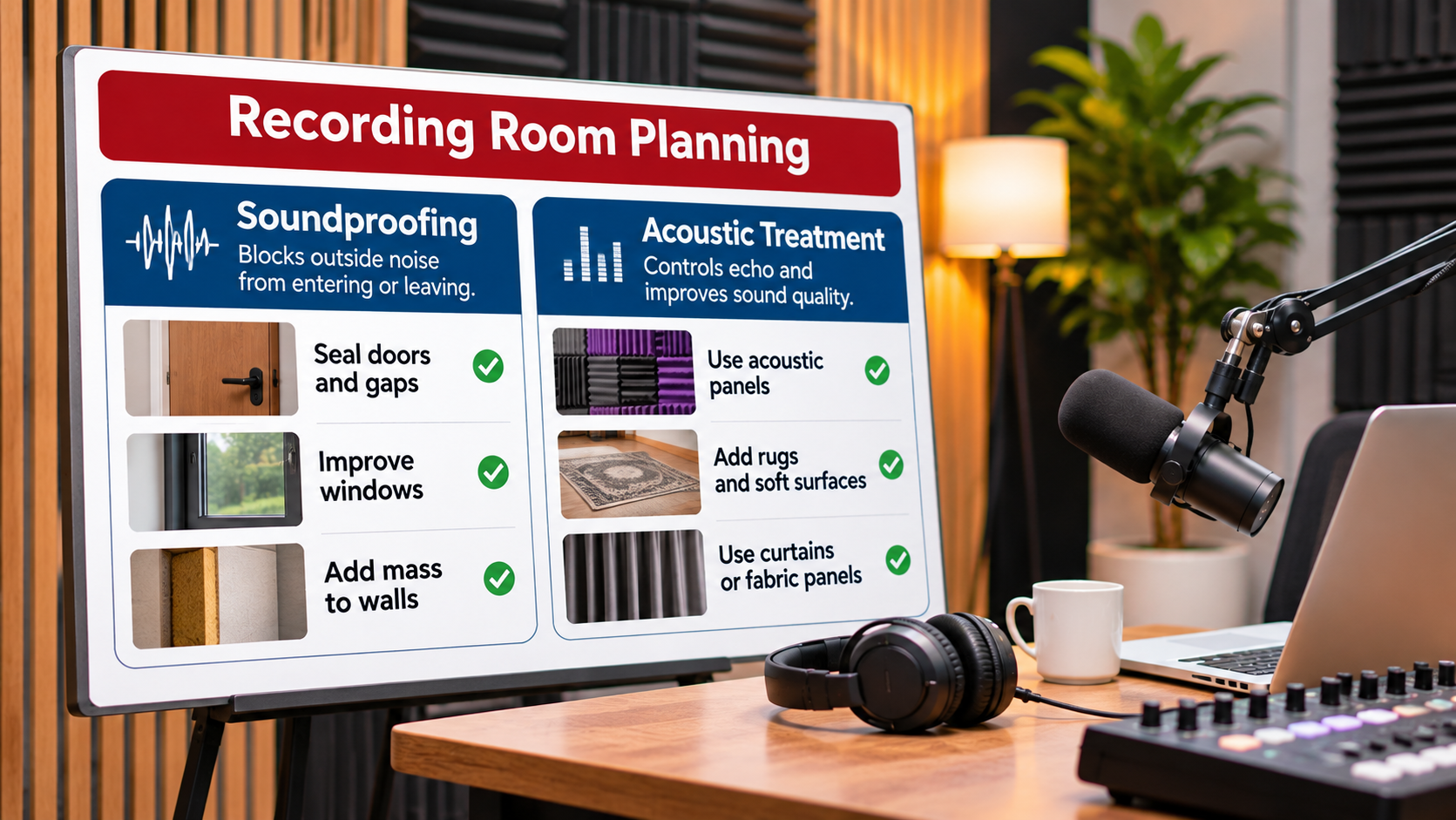
Soundproofing a room requires reducing sound transmission through doors, windows, walls, floors, ceilings, and openings. Sealing gaps can help, but significant noise isolation may require heavier materials and structural changes. Acoustic panels and soft furnishings help control indoor echo rather than block outside noise. Professional assessment can identify which improvements a recording space actually needs.
Soundproofing vs. Acoustic Treatment: Blocking Noise vs. Controlling Echo
In the world of sound, the best way to soundproof a room is usually a layered process rather than a single fix, with blocking sound and absorption serving different purposes.
Understanding the difference is important because sealing gaps, adding mass, and managing acoustics all play a vital role, and acoustic materials work by absorbing sound energy rather than stopping transmission on their own. A room can have very little echo while still allowing outside noise to enter, so insulation and related techniques help most when used as part of a broader strategy; expect improvement, not total silence.
What Soundproofing Does
Soundproofing focuses on limiting sound transmission between spaces. In the world of sound, people often confuse blocking sound with absorption.
For example, a podcast host recording inside an office may hear conversations from an adjoining meeting room. Someone recording at home may experience traffic noise, barking dogs, or activity in another part of the building. These are different techniques: soundproofing limits sound transfer between spaces, while absorbing treatment reduces echo and reverberation inside the room.
These interruptions occur because airborne noise moves through the air and enters through gaps, vents, outlets, and electrical boxes, while structure borne noise travels as vibration through framing and other solid materials. Sound often follows the path of least resistance through weak points and open spaces.
Effective sound isolation may involve sealed openings, heavier wall assemblies, improved doors, specialized windows, or structural separation.
The necessary approach depends on how sound enters the room and how much reduction is required.
Not every recording environment needs extensive construction, but persistent outside noise may require more than decorative acoustic products. Choosing the right approach plays a vital role in solving the actual recording problem.
What Acoustic Treatment Does
Acoustic treatment focuses on improving the sound inside the recording space.
When someone speaks in a room with bare walls, hard flooring, and large windows, sound reflects from these surfaces.
The reflections can create echo, excessive reverberation, or a hollow recording.
Acoustic panels, area rugs, curtains, and other absorbent materials can help control some of these reflections. Soft, lightweight materials typically work best for reducing echo inside the room.
The goal is not necessarily to eliminate every reflection. A balanced recording room should support clear, natural speech.
Acoustic treatment can improve voice recordings without providing meaningful isolation from noise outside the room. Airborne noise moves through openings, while structure-borne noise travels through connected building materials, and both follow the path of least resistance. Electrical outlets, gaps around electrical boxes, and HVAC vents can become sound pathways if they are not sealed properly.
Why Podcast Rooms May Need Both
A professional podcast recording environment should address noise entering the room and unwanted reflections within it.
For example, installing acoustic panels may improve speech clarity, and a mix of acoustic panels, area rugs, curtains, and other soft materials usually improves how the room sounds inside rather than blocking outside noise, but it will not reliably prevent a loud conversation outside the door from being recorded.
Likewise, a well-isolated room may still sound harsh if its interior surfaces create excessive reflections.
Masterly Studios provides professional podcast recording and production environments where room acoustics form part of the overall recording experience.
Businesses exploring a complete recording setup can read Podcast Studio Setup: What a Professional Recording Space Should Include.
Seal Gaps First: Doors, Windows, and Vents
Doors, windows, and other openings can reduce the effectiveness of a recording room's sound isolation. Many recording rooms need the right mix of isolation measures and interior treatment, and sealing these areas is often the first line of defense.
Even when the surrounding walls are relatively solid, sound may pass through poorly sealed areas, so it helps to seal gaps around doors, windows, outlets, vents, and lighting with acoustic caulk, weatherstripping, or foam.
For clients planning a home or office recording space, identifying these weaknesses is an important part of understanding the room's limitations.
Doors and Entry Points
Doors, windows, vents, and similar openings are the first line of defense for sound isolation, and interior doors are common sources of sound leakage.
Lightweight doors and gaps around their edges can allow voices, hallway activity, and other sounds to enter. Even small cracks can let in significant noise, so it helps to seal gaps at penetrations and along the perimeter with products such as acoustic caulk or foam where appropriate.
A properly sealed door assembly may improve isolation, although the result depends on the door's construction and surrounding walls, and some spaces may need you to install a heavier solid-core door or better perimeter seals.
For offices with frequent activity, the location of the recording room also matters.
A room beside a busy reception area may be harder to keep quiet than one located away from shared workspaces.
Windows and Outside Noise
Windows can be another weak point, especially in buildings near roads, parking areas, or active commercial spaces.
The glass, frame, seals, and surrounding construction all influence how much outside noise enters.
Curtains may help reduce some reflections inside the room, but ordinary fabric curtains should not be treated as a substitute for effective window sound isolation.
If exterior noise is a major concern, a professional assessment may be necessary to determine whether the existing windows and room construction are suitable for recording.
Air Vents and Mechanical Noise
Heating, ventilation, and air conditioning systems can introduce background noise.
Airflow, fans, ductwork, and mechanical vibration may be noticeable during quieter sections of a podcast or interview. Weatherstripping and tighter seals around the window assembly can improve sound sealing, even though curtains alone will not block much outside noise.
Ventilation also creates possible paths for sound to travel between rooms, and plumbing in ceiling cavities can further limit some isolation upgrades while adding vibration paths.
A recording space must maintain safe airflow and comfortable conditions, so vents should not simply be blocked.
Any significant ventilation modification should be evaluated by qualified building professionals.
For businesses with recurring recording needs, these complications may make an established professional studio more practical than converting an ordinary office.
Add Mass and Treatment: Walls, Panels, Rugs, and Placement
Once the primary noise sources are understood, different materials may be considered for sound isolation and indoor acoustic control, since sound is generally harder to transmit through dense materials.
These solutions serve different purposes and should not be confused, so it helps to deal with each noise path based on how it travels, including vibration from ductwork and, in some buildings, nearby plumbing.
Why Wall Construction and Green Glue Matter
Heavier and properly designed wall assemblies can reduce sound transmission.
In more demanding situations, specialized construction may combine added mass with drywall, a damping compound, and green glue between layers, because heavier, dense materials resist sound waves better than thin lightweight surfaces, while lighter approaches do less to control transmission and reflections inside the room.
Acoustic insulation can also help when fitted snugly into each wall cavity, since insulation works best when it fills the space without gaps or compression.
Further gains may come from decoupling parts of the structure with clips and channel systems, although installation details matter.
However, adding material to one wall does not guarantee that outside noise will disappear.
Sound may continue traveling through ceilings, floors, doors, adjoining walls, and ventilation systems.
The effectiveness of a solution depends on the complete room rather than one surface.
For a business planning a permanent recording space, professional acoustic and construction advice can help determine whether the required improvements are practical.
Acoustic Panels Placement for Clearer Speech
Acoustic panels placement can influence how clearly speech is recorded.
Drywall is a common wall material used to add mass, and double layers of drywall improve sound isolation more than a single layer. A damping compound such as Green Glue between drywall layers helps reduce sound vibration through the assembly. Mass-loaded vinyl can be placed behind drywall to add mass and help block sound.
Panels are generally intended for absorption of reflected sound rather than to prevent noise from entering the room.
For spoken-word recording, treatment is often considered around areas where sound reflects between the speaker, microphone, walls, and ceiling.
The most effective locations depend on the room's shape, surface materials, furniture, and recording positions.
A professional assessment can help identify which reflections are affecting the sound, while specialized construction may use decoupling methods such as resilient channel or clip-and-channel systems, and staggered seams and resilient channels can improve wall isolation. Acoustic insulation placed snugly in the wall cavity can help, but it works best alongside sealed joints and added mass; these upgrades are often easier during a renovation.
Placing panels without considering the room may improve some frequencies while leaving other acoustic problems unresolved.
Rugs, Curtains, and Soft Furnishings
Soft furnishings can improve the acoustic character of certain recording spaces.
A rug may reduce reflections from a hard floor, while heavy curtains can absorb some sound within the room.
Upholstered furniture may also help reduce reflections from nearby surfaces.
These additions can make a room sound less reflective, but they do not replace structural sound isolation.
For a business recording important interviews or branded content, the distinction matters because indoor echo and outside noise may require separate solutions.
Creating a Balanced Recording Environment
A recording room should support the people and equipment using it.
An overly reflective space may produce noticeable echo.
A poorly planned treatment arrangement may create an unnatural sound or fail to address important reflection points.
Room size, furniture, microphone placement, and the number of speakers can influence the acoustic requirements.
The ideal environment should provide controlled sound while remaining comfortable for recording sessions.
Masterly Studios considers recording quality as part of its broader professional production approach.
When a Professional Studio Setup Makes More Sense
Not every home or office can easily become a reliable recording environment.
A spare bedroom may work for occasional recording, but busy streets, shared walls, mechanical systems, and building restrictions can limit what is achievable.
For businesses and creators who record regularly, these problems can affect scheduling, production quality, and the consistency of their content.
When Outside Noise Interrupts Recording
Repeated interruptions may require sessions to be paused or sections to be recorded again.
This can be especially challenging during interviews involving executives, clients, or guests with limited availability.
If outside noise cannot be controlled reliably, using a professional recording environment may reduce the risk of disruption.
When Echo Affects Professional Communication
Echo and excessive reverberation can make dialogue harder to understand.
For businesses producing educational content, branded interviews, and podcasts, clear speech is essential.
Listeners should be able to focus on the message rather than the recording environment.
A professionally prepared studio can provide a more suitable setting for capturing spoken content.
When Video and Audio Need to Work Together
Video podcasting introduces additional requirements.
Lighting, camera positions, backgrounds, and recording equipment must work together with the room's acoustics.
A space that sounds acceptable for audio-only recording may not provide an appropriate background or sufficient room for video production.
Masterly Studios offers professional podcast and video production services in Atlanta, helping creators and businesses work in a space designed for content production.
Explore Atlanta Video Podcast and Video Production Services to learn more.
For additional information about visual production, read Podcast Lighting Setup: How to Make Video Podcasts Look Professional.
Why Professional Sound Quality Matters for Your Brand
Audio quality affects how audiences experience your content.
A business podcast may feature valuable industry knowledge, but background noise can make the conversation difficult to follow.
A video interview may look polished while sounding distant or hollow.
These problems can distract viewers and create additional work during editing.
For companies investing in marketing, employee communications, training videos, and professional interviews, a consistent recording environment helps maintain a professional presentation.
How Masterly Studios Supports Professional Recording
Masterly Studios provides studio spaces, podcast production, and video production services for businesses and creators in Atlanta.
Rather than requiring every client to build a permanent recording room, the studio offers an established production environment for creating professional content.
Clients can discuss their recording format, number of participants, video requirements, and production goals before booking.
This allows the team to explore appropriate studio and production options based on the project's needs.
For businesses considering their own home or office recording room, a discussion with the production team can also help clarify whether using a professional studio is a better fit for their recording plans.
Creating a Quiet Space for Professional Recording
A quiet space is essential for recording podcasts, interviews, and business videos without unwanted background noise. A properly designed soundproof room helps reduce distractions from traffic, conversations, and impact noise, such as footsteps or movement from neighboring rooms.
For creators who are frequently bothered by outside sounds, acoustic comfort and solitude can make recording sessions more productive. While a carpet and soft furnishings may reduce reflections inside the room, effective sound isolation often requires specialized construction and insulating materials.
The key is understanding how sound travels through the space and selecting solutions that address the actual noise problems. Masterly Studios in Atlanta provides professional recording environments for businesses and creators seeking consistent audio quality.
Why Proper Installation Matters for Soundproofing
Effective soundproofing depends on suitable materials, room construction, and proper installation. Even small gaps around doors, windows, or wall connections can reduce the performance of a sound isolation system.
Although some creators initially consider soundproofing as a DIY project, achieving reliable results may require professional assessment and structural improvements. Poorly planned changes may reduce echo without preventing outside noise from entering.
As discussed throughout this post, soundproofing and acoustic treatment serve different purposes. Businesses that need dependable recording conditions may find a professional studio more practical than modifying an existing room.
Masterly Studios offers professional podcast and video production environments in Atlanta, helping clients focus on their content rather than managing complex recording-room requirements.
Frequently Asked Questions About Soundproofing a Room
Do acoustic panels soundproof a room?
No. Acoustic panels primarily absorb reflected sound and help reduce echo inside a room. They generally do not provide meaningful protection against outside traffic, conversations, or neighboring rooms. Effective soundproofing usually requires addressing gaps, doors, windows, and the building structure.
What is the cheapest way to soundproof a room?
Addressing obvious air gaps and choosing a quieter recording location are often low-cost starting points. However, inexpensive changes may provide only limited noise reduction. Rugs, curtains, and acoustic panels can improve room acoustics but should not be confused with effective sound isolation.
Where should acoustic panels go in a recording room?
Acoustic panels are commonly placed at important reflection points on walls and ceilings near the recording area. The best arrangement depends on the room's dimensions, microphone positions, and surfaces. Professional acoustic planning can help control echo without making the recording sound unnatural.
Talk With Masterly Studios About Your Recording Space
If you are researching how to soundproof a room for podcasting, professional interviews, or business video production, the most important decision is choosing a recording environment that supports your content goals.
Some spaces may benefit from targeted acoustic improvements. Others may require substantial structural work to control outside noise.
For many businesses and creators, using a professional studio offers a more practical alternative to managing a complete recording space independently.
Masterly Studios in Atlanta provides professional podcast recording spaces and video production services designed to support clear audio, polished visuals, and organized recording sessions.
Call (404) 726-7261 to speak with Masterly Studios about your project.